Our Strategies
We work towards women’s liberation through:
- Female-centred media content: We report on women-related news, investigative stories, fact-checks, events, explainers, and articles to increase women’s visibility in the media and offer perspectives on issues that centre on women.
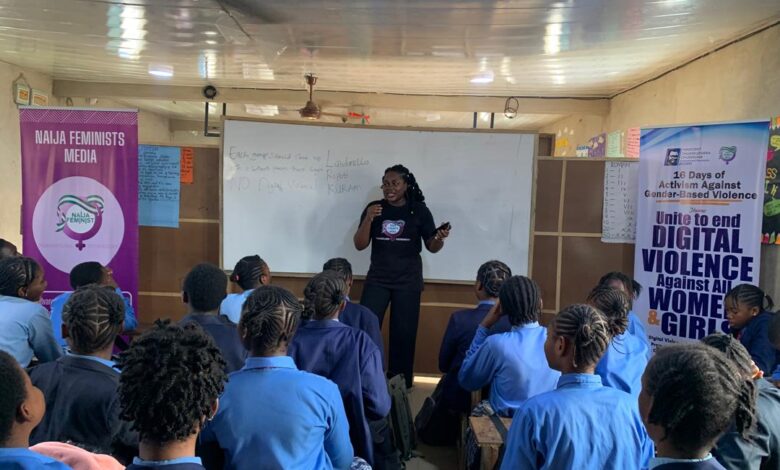
- Women’s rights advocacy: We leverage technology to advocate for women’s rights online, while organising and covering demonstrations, and on-ground events to advance gender equality
- Community engagement: We partner with people in the local community and other CSOs to promote women’s rights in their area, train local newsrooms to report on women-related stories, engage with organisations to make policies that favour women in their companies, and provide support for vulnerable women.
- High-level research: We conduct industry-related high-level research about women to ensure the free flow of accurate information about us.
- In-depth analysis: We conduct an in-depth analysis of women-related experiences towards providing accurate data to change the status quo
- Stakeholder gathering: We engage with media owners, journalists, politicians, and women’s rights advocates and other stakeholders to discuss and promote the agenda of female liberation in Nigeria
- Policy formulation and implementation: We formulate policies and policy briefs instrumental to women’s liberation and lobby for their implementation at the national level
Our Audience
Our organisation’s subjects are women and girls. Therefore, they are our primary audience.
Other key audiences are:
- Policymakers
- Media owners
- Journalists
- Community leaders
- News outlets
- Local media consumers
Why Media?
Women are discriminated against religiously, politically, culturally and socially in Nigeria. In elective and appointive political positions, women’s participation is less than 7% nationally, far 59 below 22.5% of the global average and 23.4% of the regional average (Aina-Pelemo, 2021). Also, some cultures still practice female genital mutilation (FGM) and indulge in barbaric cultures where girls are born for the sole purpose of using them to repay debt. Yet, the media has been complicit in propagating misogynistic and patriarchal narratives that have subjugated women for many years and demonised the gender equality movement.
“It sickens to see that many women today just engage in this mass of inexplicable oddity, and they tag it feminism. Our Nigerian ladies want to tailor their feminism on the premise of ‘I can’t be a slave to any man. After you are done eating, wash your plate, and I will wash mine; if you cannot wash my pants, I cannot wash your boxer. If you are not ready to clean up for your baby, then let’s not bother giving birth. How do these absurdities fit into the philosophical foundation of feminism?” One of Nigeria’s most prominent media platforms, The Cable, published on their platform on August 31, 2017; The story written by Babajide Adeokin is titled “Pro-women to anti-men movement: Nigerian wave of feminism”
Several studies have also revealed how media are created by men for the consumption of men. However, with the growth of incel culture, it is time the media steps up and undo it. Naija Feminists, therefore, leverage technological and journalistic tools to expose misogyny, improve African feminists’ representation, and empower women.
Our Journey
- Naija Feminists is a platform founded in 2021, mainly based on social media.
- In 2024, it expanded to become a media organisation representing the interests of women’s liberation through mass media, free from the influence of profitability and propaganda.
- In 2025, it became recognised as a media organisation that prioritises excellence in inclusive reporting and advocacy at the ReportHer Award
- The organisation currently has an online community of feminists with over 200 members