Dr Gladys West, Mathematician whose work made GPS Possible, Dies at 95
|
Getting your Trinity Audio player ready...
|
Summary: Dr Gladys West, a pioneering mathematician whose groundbreaking work laid the foundation for the Global Positioning System (GPS), has passed away at the age of 95. She died on January 17, 2026, at her home in Alexandria, Virginia, surrounded by family and friends, according to a statement from her family posted on social media on January 18, 2026.
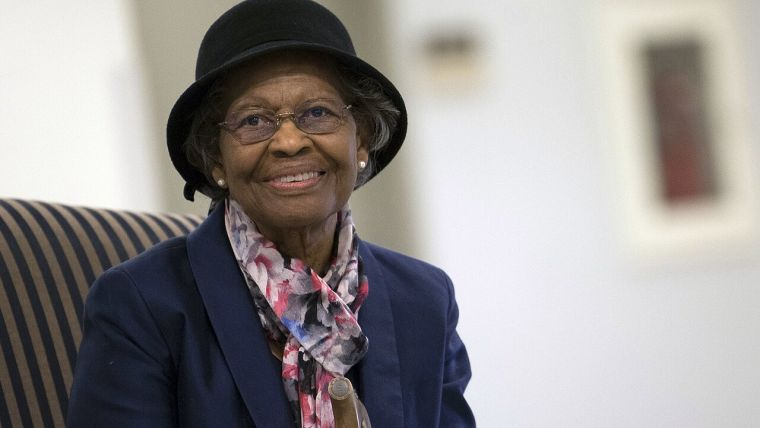
Dr Gladys West, the pioneering mathematician whose groundbreaking work laid the foundation for the Global Positioning System (GPS), has passed away at the age of 95.
Gladys died on January 17, 2026, at her home in Alexandria, Virginia, surrounded by family and friends, according to a statement from her family posted on social media on January 18, 2026.
“This morning, the world lost a pioneer in Dr Gladys West. She passed peacefully alongside her family and friends and is now in heaven with her loved ones,” her family shared. “We thank you in advance for all of the love and prayers you have and will continue to provide.”
Born Gladys Mae Brown on October 27, 1930, in Sutherland, Dinwiddie County, Virginia, Gladys grew up on a small farm in a sharecropping community during the Jim Crow era. Her parents owned a small farm, with her mother working in a tobacco processing plant and her father working for the railroad.
The Mathematician graduated as valedictorian of her high school class in 1948, earning a full scholarship to Virginia State College, now Virginia State University. She earned a Bachelor of Science degree in mathematics in 1952, at a time when mathematics was predominantly studied by men. After teaching mathematics and science for two years in Waverly, Virginia, she returned to complete her Master of Mathematics degree in 1955.
In 1956, she was hired at the Naval Proving Ground in Dahlgren, Virginia, later renamed the Naval Surface Warfare Centre. She was the second Black woman hired and one of only four Black employees at the facility at the time.
At Dahlgren, Gladys was admired for her ability to solve complex mathematical equations by hand. She eventually transitioned from solving equations herself to programming computers to perform the calculations. One of her first major projects was work on the Naval Ordinance Research Calculator (NORC), an award-winning program designed to determine the movements of Pluto in relation to Neptune.
In 1978, she was named project manager of Seasat, an experimental ocean surveillance satellite designed to provide data on oceanographic conditions and features. During the 1970s and 1980s, she developed highly accurate mathematical models of the Earth’s shape using satellite data, work that became the scientific foundation for modern GPS technology.
Dr Gladys worked at the Dahlgren Centre for 42 years, retiring in 1998. In 2018, after submitting a short biography to a sorority function, members of Alpha Kappa Alpha helped her receive belated recognition for her contributions. That same year, she was inducted into the United States Air Force Space and Missiles Pioneers Hall of Fame and honoured as Female Alumna of the Year by the Historically Black Colleges and Universities Awards.
In 2018, Dr Gladys was selected by the BBC as part of their 100 Women. In 2021, she was awarded the Prince Philip Medal by the UK’s Royal Academy of Engineering, their highest individual honour. In 2024, Virginia’s Fredericksburg City School Board voted to name its third elementary school in her honour, Gladys West Elementary School.
On March 7, 2024, an interactive exhibit dedicated to Dr Gladys’s work was unveiled at the Virginia Tech Innovation Campus in Alexandria’s Potomac Yard. The exhibit later toured several states, introducing thousands to her story.
“Dr West’s brilliance, perseverance, and quiet determination transformed the modern world in ways most of us experience every day,” Virginia State University, where West earned both her undergraduate and graduate degrees, stated.