|
Getting your Trinity Audio player ready...
|
Summary: Hamamat Montia’s journey from beauty queen to Ghana’s Shea Butter Ambassador spotlights the economic power of women in the shea industry. Her leadership challenges the undervaluation of women’s labour, advocating for fair trade, local value addition, and wealth building, transforming representation into tangible economic empowerment for African women.
At age 17, when Hamamat Montia was crowned Miss Malaika Ghana in 2006, many saw a young beauty queen stepping into the spotlight. Few could have predicted that nearly two decades later, she would emerge as one of the most visible global advocates for African women’s economic power, now serving as Ghana’s Ambassador for Shea Butter and a seventh-generation shea heiress.
Montia’s pageant career opened doors to media visibility and influence, but it was her return to her roots in northern Ghana that defined her legacy. Born into a lineage of women deeply embedded in the shea value chain, she reframed what had long been dismissed as “rural women’s work” into a global conversation about trade, culture, dignity, and generational wealth.
Ghana, the Gold Coast of Africa, has long been the backbone of a multi-billion-dollar global industry, including cocoa, shea butter, gold, and other rare earth minerals. Shea butter is often considered a woman’s crop because women pick the fruit and extract its butter, earning it the name “woman’s gold.”
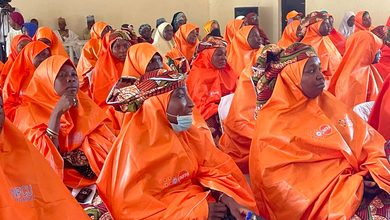
Yet, for generations, the women who traverse this land, the pickers, the crushers, and the stirrers have remained the industry’s most exploited demographic. Their underpaid labour is showcased and romanticised by the media as heritage and culture, but they are not brought to the tables where deals and policies are negotiated, despite shea butter contributing approximately $100 million to Ghana’s economy.
Photo credit: Hamamat
A PhD thesis ‘Investigating the sustainability of the shea industry among rural women in Northern Ghana’ spotlights the exploitation of rural shea butter makers in Northern Ghana, showing “the profit margin of a shea nut picker as Gh₵ 8.82 (66 US cents) while a middleperson earned Gh₵ 49.5 (US$4) on a 100kg bag of shea nuts. Similarly, a shea butter extractor earned Gh₵ 1.92 (8 cents) while a middleperson earned Gh₵ 63.42 (US$6) on a 25kg box of shea butter”.
Yayah et al, who investigated this injustice on rural women, shared some interviews which show that these middlepersons exploit these women due to language barriers, financing, poor regulation and market access.
“We are always here, and we see people troop in for them (shea butter). Because we don’t understand the English language, they always ask for Madam…
“For the money, it is my own money I use to process the Shea butter, but there are times madam (middleman) gives us money to process, and after selling, she takes her money” (Pre-financing)
“Those with much power, I will say, are the middlepeople who buy from the pickers, and we also buy from the middlemen. They have the power because if they don’t go to the communities to buy and sell, we won’t also get to buy or sell” (Power Dynamics)
“The buyers of shea butter have the most power because they come to buy. If they don’t buy, we run at a loss. As of now, we have some shea butter stored in the storeroom because the demand is slow” (Market access)
“…because they finish cutting down the shea trees, it is no more there, but the villages that haven’t yet built houses around still have some of the shea” (Shea Resource Exploitation)
This gendered imbalance reflects a broader pattern across extractive and agricultural economies; women’s unpaid or underpaid labour subsidises global supply chains without translating into ownership, capital access, or wealth accumulation.
Montia has been unapologetic in naming this injustice. Through her brand and advocacy, she has repositioned shea butter not as a “raw export commodity,” but as a site of African intellectual property, women’s heritage, and economic sovereignty. By centring the stories of rural women and investing in local processing and branding, she challenges a system that often adds value and captures profits outside the continent.
Photo Credit: Hamamat Instagram
In an era of Eurocentric beauty standards, Hamamat pivoted, using her digital platform to romanticise the village life that global capitalism had taught many to feel ashamed of. She didn’t just sell butter; she sold the heritage of her ancestors. As a 7th-generation heiress to the shea craft, she founded HAMAMAT African Beauty, bridging the gap between the rural “She-yebas” (shea mothers) and the global luxury market. She also established the first shea butter museum in Ghana, which has become a popular tourist attraction centring the culture, creativity, history, healing and trade involved in the shea butter lifecycle. The museum serves as a raw reminder of the labour that goes into traditional shea refining, showing the soot, the sweat, and the communal singing that accompanies the birth of “Women’s Gold.”
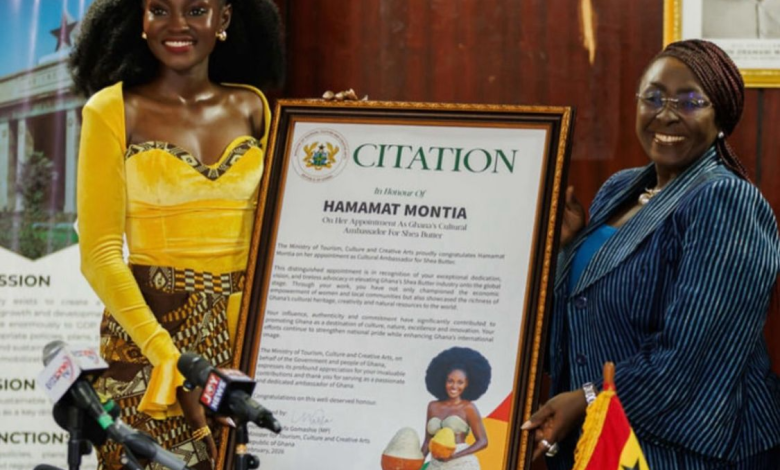
Hamamat’s appointment as Ghana’s first Shea ambassador is a strategic disruption of this cycle. By placing a woman who understands both the spiritual heritage and the commercial potential of shea at the helm, Ghana is signalling a move toward Trade Justice. This recognises the labour of the rural woman not as a “charity case,” but as a master craftsperson. Through her consistent advocacy for gender equality, girl-child education, and women’s empowerment. Her mission focuses on ensuring that the transformation from nut to luxury cream happens in the village, keeping the profit where the work is done. As an ambassador, she carries the mandate to negotiate better terms for Ghanaian shea on the global stage, ensuring that “Women’s Gold” finally enriches the women who hold the spoons.
As the world shifts towards ethical sourcing and sustainability, Montia’s leadership reframes shea butter from a cosmetic ingredient to a story of women’s endurance, innovation, and economic agency. Hamamat Montia represents a new guard of African leadership, one that uses the visibility of the Influencer to protect the dignity of the labourer.
For the women who harvest shea nuts under the scorching sun, who carry the weight of baskets of shea nuts and the multi-million dollar industry on their heads for generations, the She-yebas (shea mothers) whose woman power and shoulders serve as shea butter refinery for centuries, the voice that serenades the shea extraction process and negotiate business deals in languages they barely speak or understand, this moment matters. It is beyond representation but a redistribution of value, visibility, and wealth.
This generation of shea heiresses is not just picking nuts; they are owning the factories, the brands, the history and the futures women have spent centuries stirring into existence, recognising that women’s unpaid and undervalued work deserves structural investment, formalisation, and profit participation.