6 Must-Read Poetry Collections by African Authors
|
Getting your Trinity Audio player ready...
|
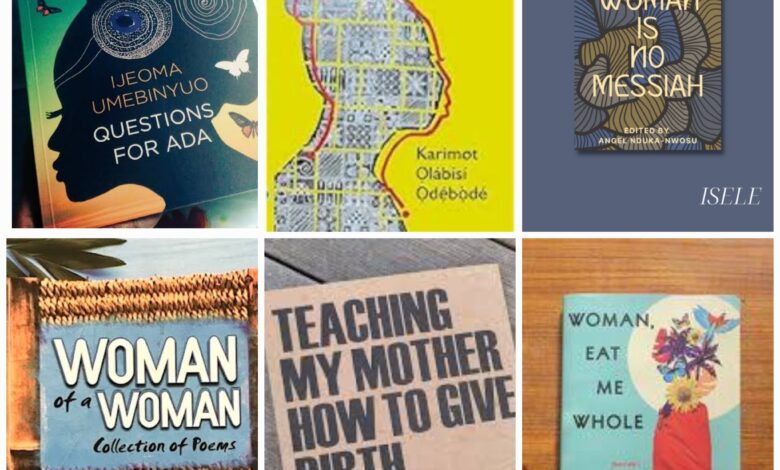
In this week’s book review, Naija Feminists Media explores six poetry collections that navigate womanhood, domestic violence, resilience, hope, feminism, and patriarchal frameworks that restrict women. From Questions For Ada by Ijeoma Umebinyuo to A Woman Has Many Names by Karimot Odebode to The Woman is no Messiah — An Anthology. These poems did not ask for permission; they gave women the ultimate power.
- Questions For Ada— Ijeoma Umebinyuo (Nigerian)
As a Nigerian from the Igbo tribe, the titular name “Ada” rings a bell, evoking a familiar meaning – the firstborn daughter. Naturally, one might assume this Poetry collection wants to address the dilemma of the firstborn daughters. Alas! Ijeoma Umebinyuo proves this assumption wrong; instead, the titular name is used to portray the collective archetypes of all women navigating the systemic, domestic, and emotional burdens of a patriarchal world. Rather than a scattered anthology, the book functions as a comprehensive emotional roadmap organised into four themes: the inheritance of pain, radical love and reclamation, healing, flight, resistance, and the dislocation of African migrants.
From the voice of a wife dealing with a cheating husband, to a daughter suffering from domestic abuse but turned away by her family. To a young girl abused by her employer. To a heartbroken young woman healing, to women supporting women. Ijeoma strongly challenges the notion that a woman’s body is merely a vessel built to endure suffering. The poems are written in the simplest diction, with each sentence carrying language weight. Yet, each verse is an ode to the unique experience of being a woman.
- A Woman Has Many Names – Karimot Odebode (Nigerian)
A Woman Has Many Names is the debut poetry collection by Nigerian poet, lawyer, and United Nations SDG youth leader Karimot Olábísí Odébòdé. Published by Noirledge Publishing and released in March 2022, the poetry coincides with International Women’s Day. It contains 107 poems that celebrate womanhood, confront gender inequality, and turn shared trauma into songs of triumph. The collection is a finely knit thread of poems that focus on issues women are too scared to share, turning their fears into invigorating songs while also reassuring them of their innate ability to triumph over travails. Karimot also deploys her craft to explore other issues such as nationhood, governance, love, hope, persistence, and self-worth. The poet also challenges the societal narrative that equates marriage with a woman’s primary achievement.


- The Woman is no Messiah — An Anthology (Nigerian)
In a country where womanhood is synonymous with suffering, unpaid labour, and being burdened with putting up with men’s caprices and inadequacies. Twenty-eight Nigerian women document their joy, love, laughter, fears, shame, and grief to produce a poetry collection. They reject the endless sacrifice syndrome and push back against the societal expectation that a woman should put everyone else’s needs before her own. The anthology is edited by Nigerian poet, editor, and feminist Angel Nduka-Nwosu and published by Isele Magazine in 2022.
The poems’ verses challenge the normalisation of women’s suffering and question why the real effects of events like the Endsars/2020 pandemic lockdown were not checked from a woman’s perspective. It highlights a sisterhood rooted in shared dreams, laughter, and pleasure. Contributing authors include: Roseline Mgbodichinma, Funmilayo Obasa, Bunmi Africa, Hassana Maina, Olivia Yetunde Alabi, Glamour Adah, and Omotoyosi Salami.
- Woman of a Woman — Funke Awodiya (Nigerian)
Woman of a Woman is a 60-page poetry collection by Nigerian writer and poet Funke Awodiya. It celebrates womanhood, identity, power, and agency. It also functions as a poetic documentation of societal expectations and the historical realities women face. Published by Something for Everybody Ventures in 2020, the poem’s title, “Woman of a Woman,” celebrates the physical form and intrinsic power of the African woman, leaning into heavy, musical alliteration.
From a feminist perspective, the collection functions as a tool for political awakening and resistance. This is clearly explored in the poem “Woman-up”; Funke directly challenges the cultural and institutional restrictions that seek to diminish female potential. In “Fateful Wives,” she explicitly warns against the dangers of staying in abusive relationships by addressing domestic abuse openly.
A central pillar of feminist literary criticism is the retrieval of female voices from historical erasure. Funke uses her poetry as a creative archive to immortalise iconic Nigerian women who shaped society. By placing historical icons such as Queen Amina, Prof. Dora Akunyili, Chioma Ajunwa, and Ladi Kwali in her anthology, she counters the male-centric historical framework and asserts that Nigerian women are not mere passive observers of history but active, heroic architects of national development.
- Teaching My Mother How To Give Birth — Warsan Shire ( Somali)
Somali-British writer Warsan Shire’s poetry collection, Teaching My Mother How to Give Birth, contains 21 vivid poems exploring womanhood, displacement, trauma, and cultural identity. Originally, the poetry title emerged from the Somáli proverb “Waa dhalaankii dhalmada hooyadood baray”, which literally means: “these youth taught their mothers how to give birth.” On closer examination, the poetry chapbook can be seen as an exhortation to first-generation women, who have been compelled to internalise their oppression under patriarchy, but must unlearn patriarchal subjugation and start singing a new song of liberation.
In “Things We Had Lost in the Summer,” the poet explores the theme of the policing of women’s bodies in alignment with socialisation. She narrates a negative childhood development which resulted in the perpetuation of rape culture and violent masculinities. In the poem, Warsan illustrates the presence of female masculinity and rejects unorthodox forms of female expression, unfairly categorising them as abhorrent. Ultimately, Teaching My Mother How to Give Birth dives deep into the construction of war in order to confront the faces of patriarchal culture and oppression.
- Woman, Eat Me Whole — Ama Asantewa Diaka ( Ghanaian)
Woman, Eat Me Whole is the debut poetry collection by Ghanaian poet and spoken-word artist Ama Asantewa Diaka. The collection is published by Ecco Press, a HarperCollins imprint, and was released on April 5, 2022. The 48-poem collection explores themes of beauty, mental health, trauma, womanhood, and more. Ama presents a rich representation of the female body and experiences against the backdrop of societal expectations, drawing on her experiences in Ghana and the US.
The poems dive deeply into the raw realities of the female form, discussing menstruation, physical illness, and sexual consent. While patriarchy often demands that women shrink, hide their body functions, or reshape themselves to fit standard beauty metrics. The poet rejects this idea by writing about the body with visceral, unapologetic language. She deftly uses her poetry as a reclamation to celebrate the flesh-and-blood reality of African womanhood rather than an idealised, polite fantasy.
Ama Asantewa Diaka’s Woman, Eat Me Whole is a powerful manifesto that dismantles patriarchal structures and reclaims narratives from conservative traditionalism; the collection establishes a critical blueprint for contemporary African feminism.