|
Getting your Trinity Audio player ready...
|
A report by the DOHS Cares Foundation has documented 182 femicide and gender related killings of women and girls across Nigeria in 2025, exposing very significant failures in prevention, documentation, and accountability.
The 2025 Nigeria Femicide Annual Documentation Report, which covers cases recorded between January and December 2025, found that the killings occurred across at least 30 states and the Federal Capital Territory. Delta State recorded the highest number of documented cases with 21, followed by Lagos with 14, while the FCT and Ogun State recorded 12 cases each.
But beyond the number of women and girls killed, the report points to a more troubling revelation: in many cases, the systems responsible for documenting the deaths, preventing further violence and pursuing perpetrators failed to provide a clear path to accountability. Of all of these 182 cases documented, only five, 2.7 per cent, were recorded as having progressed to a formal charge in court. Another 52 cases involved suspects who were arrested or held in custody, but the report found that 47 remained at the investigation stage without an arrest being reported, while 16 suspects were still at large or wanted. For 51 cases, representing 28 per cent of the total, there was no further information on the justice outcome. Taken together, the report estimates that 62.6 per cent of the documented cases showed no concrete progress towards accountability, including cases still under investigation, cases involving suspects at large and cases with no further information.
The report found that intimate partners constituted the largest identifiable category of perpetrators. Husbands, boyfriends, fiancés and former partners were linked to 60 cases, representing 33 per cent of all documented killings. Family members outside intimate relationships accounted for another 26 cases. Combined, intimate partners and non-intimate family members were responsible for 86 cases, or 47.3 per cent of the total. The findings challenge the idea that femicide is primarily a matter of random attacks by strangers. According to the report, nearly half of the documented killings were committed by people within the victim’s own families or intimate circles, making proximity and existing relationships a central part of the risk faced by women.


Domestic and intimate partner violence was also the largest identifiable underlying cause, accounting for 43 cases. Other documented causes included ritual killings, relationship conflict or alleged infidelity, rape and other sexual violence, robbery, kidnapping and banditry, witchcraft allegations, medical negligence and police or state violence.
The data is also disappearing before it can tell the full story. The report identifies major gaps in how femicide cases are documented. The cause of death was unspecified in 61 cases, representing 33.5 per cent of the dataset. The method of killing was unknown in 62 cases, while weapon information was unavailable in 100 cases, more than half of all documented cases.
The victim’s age was also missing in 93 cases, meaning that the ages of more than half of the women and girls documented could not be established from the available records. Among the 89 cases where an age was recorded, victims ranged from 13 to 80 years old. The report notes that at least 11 victims were aged 19 or younger, including children as young as 13. For DOHS Cares Foundation, these gaps are not merely statistical problems; missing information makes it more difficult to identify patterns, determine risk factors and develop interventions capable of preventing future killings.
The report also documented severe violations of victims’ bodies in 40 of the 182 cases. These included dismemberment, body dumping or concealment, burning, decapitation and genital mutilation. Dismemberment was recorded in 11 cases, while nine involved the dumping or concealment of victims’ bodies. Six cases involved genital mutilation, either alone or alongside other forms of extreme violence. Stabbing was the most frequently documented method of killing, accounting for 29 cases, followed by beatings in 16 cases and cutting or hacking with machetes or axes in 13 cases. Eleven cases involved rape alongside other fatal injuries.
Among the cases categorised as police or state violence, the report highlights two incidents involving actors operating under state-affiliated structures. In March 2025, an unidentified girl was reportedly killed in Mgbakwu Aborgu, Anambra State, by members of “Udogachi”, a vigilante group the report says was reportedly established by the state government. The group had allegedly been involved in harassing women whom its members considered to be indecently dressed. No arrests were recorded in the case.
In September, Blessing Eze was stabbed to death at Ifo Market in Ogun State after reportedly refusing to pay an unauthorised ₦1,500 levy demanded by a state-backed market enforcer. The alleged perpetrator was subsequently killed by a mob before facing formal prosecution.
These cases raise questions about oversight and accountability where violence is carried out by individuals operating through government-affiliated structures.
The report argues that the recurring patterns cannot be addressed through prosecution alone. It describes Nigeria’s response to femicide as largely reactive, with institutions often becoming involved after violence has already occurred rather than identifying women at risk and intervening before violence escalates.
Its findings point to four major gaps: a visibility gap caused by poor documentation, a prevention gap driven in part by intimate partner violence, an accountability gap reflected in the low rate of formal prosecution, and a coordination gap created by the absence of a unified national response.
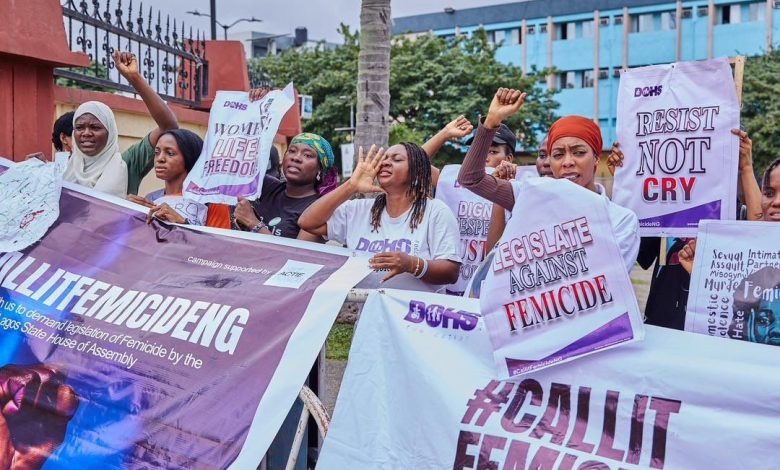
Subsequently, DOHS Cares Foundation called for legislation recognising femicide as a distinct gender-related crime, alongside a statutory National Femicide Watch, national standards for data collection, stronger domestic violence prevention measures and mechanisms for tracking cases from investigation through prosecution. It also recommends integrating healthcare institutions into femicide prevention, strengthening protection and early intervention for women at high risk, and establishing clearer responsibilities across government ministries, security agencies, healthcare institutions, social welfare bodies and civil society organisations.
The report’s central argument is that documenting women’s deaths cannot be the end point. In its first five months of 2026 alone, DOHS Cares Foundation says it tracked 54 additional femicide cases, underscoring that the patterns identified in the 2025 data have not disappeared.
The organisation is therefore advocating for a shift from documenting women after they have been killed to building systems capable of identifying danger, intervening earlier and holding perpetrators accountable. It is not simply that women are being killed; it is that the systems around them are still failing to consistently recognise the warning signs, prevent escalation and deliver justice when those systems fail.