Gloria Steinem: The Icon Who Forged Alliances with Black Feminists, Shaped Feminist Journalism
|
Getting your Trinity Audio player ready...
|
There is something slightly surreal about discovering Gloria Steinem through Mrs. America. In the FX miniseries, she appears in the middle of one of the most important political battles of 1970s America: the fight over the Equal Rights Amendment. Played by Rose Byrne, she is surrounded by women whose names have become inseparable from the era, like Shirley Chisholm, Bella Abzug, Betty Friedan, and Florynce Kennedy, while on the other side stands Phyllis Schlafly, whose campaign against the ERA would become one of the most effective conservative political movements of its time.
The series was much more than an amendment. It is about what happens when women decide political power should no longer be something they can’t participate in, and at the centre of that story is Gloria Steinem. That was probably the most fitting way to encounter her. Watching Mrs. America can leave a viewer wanting to know what happened to the woman behind the character.
That curiosity has produced more than one screen interpretation. In 2020, Julie Taymor’s The Glorias offered a cinematic portrait of Steinem’s life, with four actresses portraying her at different ages. The film placed Steinem’s life alongside the Black feminists and other activists who shaped her politics, including Dorothy Pitman Hughes, Florynce “Flo” Kennedy, Dolores Huerta and Wilma Mankiller. Then there is the real woman, whose life was considerably larger than any screenplay could contain.


Gloria Steinem died on September 2, 2026, at the age of 92, after more than six decades of journalism, activism and organising. By the time of her death, she had become one of the most recognisable figures in the modern women’s movement, but recognition is not the most interesting measure of her life. What matters is what she did with that visibility; she turned it into a political institution for women and journalism. And most significantly for anyone working in feminist media today, she helped create a publication through which women could finally look at their own lives and see them treated as news. That publication was the Ms. Magazine.
The woman before the icon
Gloria Marie Steinem was born on 25 March 1934 in Toledo, Ohio. Her childhood did not resemble the polished public image she would eventually acquire. Her father was a travelling salesperson, and her family spent part of her early childhood moving around the country. In 1944, her parents divorced.
Gloria, still a child, became responsible for helping care for her mother, Ruth, whose mental illness affected the family. She eventually attended Smith College and graduated magna cum laude in 1956 with a degree in government. A fellowship then took her to India for two years. Gloria later credited her time in India with introducing her to grassroots organising and forms of political activism that differed from the political institutions she had known in the United States.
The National Women’s History Museum identifies this period as an important influence on the activism that would later define her work, including her involvement in the women’s liberation movement and the Equal Rights Amendment campaign. She returned to the United States and moved into journalism.
But journalism, as Gloria encountered it, had very definite ideas about what a woman writer was supposed to be; she wanted to write about politics, but editors wanted her to write about food, fashion and women’s lifestyle. The problem was not that she lacked political ability; it was that the people assigning the stories did not necessarily imagine a woman as a political reporter. Gloria later described being offered assignments that had little to do with the political subjects she wanted to cover. At one point, she was even sexually propositioned by an editor. There was, she said, no language for what was happening to women in workplaces like this.
“There was no word for sexual harassment then. It was just life.”
That sentence tells us something about the world into which Steinem entered journalism: women were working and writing while also facing discrimination, but much of it had not yet acquired the vocabulary that would let society identify it as a political problem. Gloria would spend much of her career helping to create that vocabulary.
In 1963, Gloria took an assignment that would become one of the most famous pieces of her early career. She went undercover as a Playboy Bunny at the Playboy Club and wrote about what she experienced there for Show magazine. The resulting investigation, “A Bunny’s Tale,” exposed the conditions faced by women working at the club, including low pay, degrading treatment and sexualised expectations. It also made Gloria nationally recognisable.
Even though there’s a bit of an irony here, because a woman who wanted to be taken seriously as a political journalist became famous partly because she had entered one of the most sexualised workplaces in American popular culture undercover, Gloria learned how powerful journalism could be when it took an experience that people dismissed as ordinary and forced them to look at it differently.
She continued political journalism and, in 1968, helped found New York magazine, where she worked as a political columnist and writer; then feminism stopped being a subject she could observe from a distance. It became her life. At 22, Steinem had an abortion in London at a time when abortion was largely illegal in the United States. For years she did not speak publicly about it. Then, in 1969, she attended an abortion speak-out in Greenwich Village. Women stood up and told stories about abortions they had undergone in secrecy. Gloria said she heard her own experience in theirs. She had spent years writing about other people’s lives; now she had understood something that would become central to her feminism: private experiences could be political evidence.
The shame surrounding abortion was not simply an individual woman’s problem. Law, religion, medicine, economics, and social expectations produced it. Gloria began speaking publicly about her own abortion and became increasingly involved in the women’s movement. She later described the 1969 speak-out as the beginning of her life as an activist.
At that time, the women’s movement was growing rapidly, and the fight over what equality actually meant was about to move directly into American constitutional politics. The Equal Rights Amendment. This is the part of Gloria’s history that Ms America captures so effectively.
The Equal Rights Amendment had actually been introduced decades before Steinem’s rise. Congress first proposed it in 1923, three years after the ratification of the 19th Amendment. It aimed to prohibit legal distinctions based on sex and establish constitutional equality between women and men. But in the 1970s, the ERA became a central battleground of the modern women’s movement.
Gloria campaigned for the amendment and testified in its favour before the Senate Judiciary Committee in 1970. The following year, she joined other feminist leaders in creating the National Women’s Political Groups, an attempt to solve a problem the movement had identified clearly: women could protest outside political institutions forever, but without political power they would remain dependent on politicians to decide whether women’s demands mattered. The founders included Gloria, Shirley Chisholm, Bella Abzug, Betty Friedan and Fannie Lou Hamer, alongside hundreds of other women. The organisation’s stated purpose was to increase women’s participation in political life as candidates, delegates, officials, campaign organisers and voters.
Gloria’s feminist story is sometimes told as though she appeared alone at the top of the movement. She did not; she was working alongside other women from different backgrounds and ethnicities like Shirley Chisholm and Fannie Lou Hamer, Congresswoman Bella Abzug, Betty Friedan and hundreds of activists from across the country.
Her feminism developed alongside the civil rights and Black liberation movements, and she increasingly argued that gender could not be separated from race, class and other forms of power. Her 1969 essay, “After Black Power, Women’s Liberation,” helped establish her as a national feminist figure. She subsequently travelled and spoke with Dorothy Pitman Hughes, a Black feminist, community organiser and activist. Their partnership became one of the most recognisable visual representations of the women’s movement. The photograph of Steinem and Hughes sitting together is still very iconic.
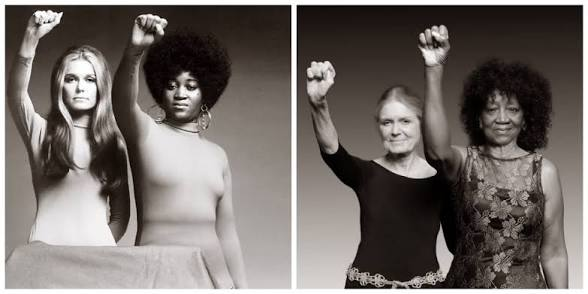
Source: Good Black News
The relationship also forced Gloria and the broader white feminist movement to confront a problem that could not be solved by simply adding black women to existing feminist spaces; sexism did not operate separately from racism, black women experienced both. Gloria’s later feminism increasingly embraced that analysis; her own account of her career describes her work as addressing equality across gender, race, class and national boundaries. Gloria’s importance is not that she single-handedly invented intersectional feminism; she became one of the movement’s most powerful platforms and increasingly used it to argue that feminism could not stop at the experiences of relatively privileged white women.
The Creation of Ms Magazine
In the early 1970s, feminist newsletters and local publications existed, but no major national magazine treated feminist ideas and women’s political lives as serious journalism. Gloria joined journalists Patricia Carbine and Letty Cottin Pogrebin in creating what became Ms. magazine. The preview issue appeared as an insert in New York magazine in December 1971. They printed 300,000 copies, and they sold out in eight days. The publication received approximately 26,000 subscription orders and more than 20,000 letters from readers within weeks. That response was not merely evidence that a magazine had found a profitable niche; it revealed an enormous audience of women who had been waiting to see their lives reflected in a different kind of publication.
Ms. Magazine did not simply tell women how to be “better women.” It asked why women’s lives were organised the way they were; it reported on abortion, advocated for the ERA, covered domestic violence and sexual harassment, examined date rape, evaluated presidential candidates according to their positions on women’s issues and challenged the influence of advertisers on journalism.
According to Ms.’s own institutional history, it became the first national magazine to make feminist voices audible and feminist journalism tenable on that scale. She didn’t just become a woman allowed to write about women; she helped build a publication where women’s political lives were the subject.
A feminist publication exists because someone has decided that women’s stories deserve more than occasional attention when they become sensational enough for mainstream media. Ms. Magazine was created at a time when mainstream women’s magazines could devote enormous space to beauty, marriage and domestic life while treating the women’s movement itself as marginal.
Naija Feminists Media (NFM) also exists in a completely different media environment, but the fundamental editorial question remains remarkably familiar: what happens when women decide to document themselves? For Gloria, the answer was creating Ms Magazine.
The women behind NFM have their own answer too. The difference is that Naija Feminists Media operates in Nigeria, in an era of digital journalism, social media, online harassment, rapidly circulating misinformation and an audience that can move between news, activism, and personal testimony within seconds. Women do not need to wait for the misinterpretation of mainstream media.
That may ultimately be one of Gloria’s most useful legacies for feminist journalism. It is easy to remember Gloria as a writer because writing was where she began, but look at the organisations associated with her career and another picture emerges: She helped establish the National Women’s Political Caucus, She helped found the Women’s Action Alliance, which worked on non-sexist and multiracial children’s education and She was involved in the creation of the Ms. Foundation for Women, She helped establish Voters for Choice, and in 2005 she co-founded the Women’s Media Center with Jane Fonda and Robin Morgan again confronting the question of women’s visibility and representation in media.
Gloria repeatedly encountered structures that excluded women and then tried to build alternatives. This is why just calling her a feminist writer might undersell her, because she was an institution builder. Gloria repeatedly rejected the idea that she was the women’s movement, and that the movement was much larger than her.
The unfinished business of the ERA
The Equal Rights Amendment is perhaps the clearest example of both Gloria’s influence and the unfinished nature of her work. Congress passed the ERA in 1972 and ultimately received ratification from 38 states, the number required under Article V. But its constitutional status remains contested because Congress’s original ratification deadline expired. The National Archives states that under existing legal precedent, the Archivist cannot certify the ERA as part of the Constitution without further congressional or judicial action; that means the battle Steinem spent decades fighting remains, remarkably, unresolved, but she kept fighting it.
Ms. reported after her death that Gloria continued to regard ERA ratification as critically important and remained involved in the campaign until the end of her life; this is an important detail in assessing her legacy. She kept pointing towards what had not been achieved, because the ERA was never simply about a symbolic declaration that women and men were equal. It represented a constitutional problem against sex-based discrimination.
Gloria belonged to the generation that helped popularise the phrase “women’s liberation.” But she lived long enough to see feminism move through several generations of political thought. She witnessed the emergence of black feminism as a powerful intellectual and political force; she saw reproductive rights become one of the defining political battles in the United States; she saw feminism enter universities, workplaces and popular culture; she also saw younger feminists challenge the movement she had helped build, and she remained engaged.
Her politics were not without controversy. Her positions and alliances were debated, challenged and sometimes changed over the decades, and her early relationship to the CIA has remained part of the complicated record of her political history, but this needs to be erased to establish her significance. In fact, it makes the profile better.
A feminist movement that takes its own history seriously should be able to say that one of its most influential leaders accomplished extraordinary things while also being a person shaped by the limitations, arguments and contradictions of her time; Gloria herself understood that movements were larger than individual leaders.
What she leaves behind
In 2013, Barack Obama awarded Gloria the Presidential Medal of Freedom, the highest civilian honour in the United States. By then, she had spent more than forty years being told in different ways that feminism was unnecessary, excessive, divisive or already solved. At 66, she married David Bale, having spent most of her life outside the conventional expectations of marriage and motherhood. She continued travelling and speaking well into her later years, and she continued writing, continued organising, and insisting that feminism was not a finished project. That may be the most striking thing about her longevity.
And when she died at 92, the reaction was not simply to the death of a famous woman. It was to the passing of one of the people who had helped make modern feminism visible enough to become a political force. It is not uncommon for someone who becomes this famous to tell the history as though everything began with them, and it did not.
Gloria knew how to use journalism as an organising tool and how to move between grassroots activism, mainstream media and political institutions. For more than half a century, Gloria Steinem used the privileges and platforms she acquired to make women’s equality harder to ignore; even though she didn’t win every time, the ERA is proof of that. But movements are not measured only by their wins; they are also measured by whether they leave behind people who know how to keep fighting, and we can attest that Gloria left behind a number of them.
And women who never met her women who encountered her through a magazine, a book, a documentary, a television series, a speech or a story about the movement she helped build continue to discover the same thing that so many women discovered when Ms. Magazine first appeared on newsstands in 1971: she was a feminist icon.