|
Getting your Trinity Audio player ready...
|
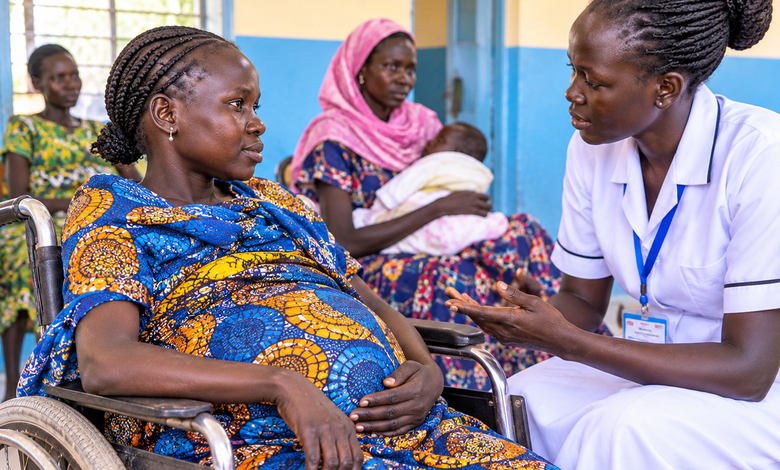
For some women with disabilities in Wau, South Sudan, reaching a health facility during pregnancy is only the beginning of the struggle. Getting timely antenatal care, communicating with health workers and receiving assistance during labour can depend on whether someone accompanies them, whether the facility is accessible and whether they can afford the services they need. Staff attitudes can also matter.
Some women described how disability shaped their experiences of pregnancy and childbirth. Their accounts raise questions about whether maternal healthcare in Western Bahr el Ghazal State is accessible to all women, regardless of disability or financial circumstances.
One woman, who asked not to be identified for personal reasons, has six children: three boys and three girls. She said health workers supported her first three pregnancies by encouraging regular antenatal visits and giving her priority when she arrived at the hospital.
During those pregnancies, she said, doctors and midwives assisted her during delivery. She felt that her disability did not prevent her from receiving the care she needed.


But her experience changed during her last three pregnancies. She said she received less attention and struggled to get assistance, including when she needed help climbing onto a delivery bed.
“During my first three pregnancies, the midwives advised me to attend regular antenatal visits for my health and the baby’s wellbeing. When I went to the hospital, they did not make me wait in the same line as other women; they served me first,” she said. “During my last three pregnancies, I suffered. If you do not have money, you receive less care. If nobody accompanies you, nobody helps you onto the delivery bed. I urge nurses and midwives to consider the challenges women with disabilities face and treat them with care.”
Her account suggests that support can vary over time and may depend on a woman’s ability to pay or whether she has someone available to assist her. It also points to the importance of accessible facilities and respectful treatment, not simply the availability of maternity services.
Another woman, who also requested anonymity, has five children. She said she gave birth to her first three children before losing her sight in an accident. After becoming blind, she found it more difficult to attend antenatal appointments and navigate the hospital without assistance.
During her fourth pregnancy, she said, no one was available to accompany her to the hospital. As a result, she struggled to attend routine antenatal check-ups. She also described being blamed for becoming pregnant despite being blind.
In her fifth pregnancy, she went to the hospital without a family member. She said she received insults from health workers, endured prolonged labour and gave birth before her relatives arrived.
“I could not see, and there was nobody to accompany me to the hospital. It was difficult to attend my antenatal appointments,” she said. “When I became pregnant again, some health workers questioned why I would become pregnant when I knew I was blind. During my last delivery, I went alone. Nobody was there to guide me or explain what I should do. I struggled with labour pains for a long time, and my family arrived only after I had given birth.”
She called on health workers to treat women with disabilities with compassion, saying disability can affect anyone.
“You may be born healthy and later acquire a disability. We should treat one another with humanity,” she said.
The two women’s experiences are personal accounts and do not establish how frequently such treatment occurs at Wau’s health facilities. However, an organisation representing people with disabilities says barriers to maternal and reproductive healthcare remain a concern.
Lino Madut Nyipouch, executive director of the People with Disabilities Society in Wau, said the organisation advocates for the rights of people with disabilities, including their right to maternity healthcare. It also conducts awareness activities and works with health authorities on reproductive health issues.
Nyipouch said the organisation had not received an official report documenting all the barriers women with disabilities face. However, assessments by the organisation identified gaps in access, including a lack of ramps and sign-language interpreters, as well as health services that are not always provided free of charge.
“From the assessments we conducted, we found that there are no ramps and no sign-language interpreters for women with hearing impairments. Not all health services are free, which makes it difficult for some women with disabilities to obtain the care they need,” he said.
He said the organisation wanted women to report challenges so it could strengthen its advocacy and work with health authorities to improve access.
Nyipouch also recounted a case involving a pregnant woman with a physical disability who was admitted to a maternity waiting home. According to him, she was prepared for an operation, but no family member, including her husband, was present to sign the consent form. He said the operation did not proceed and the woman later died at the hospital.
The circumstances surrounding the woman’s death were not independently established through the interviews available for this report. The account nevertheless raises serious questions about how hospitals handle consent when a patient has no relative present, and what safeguards exist to ensure that a person with a disability is not left without urgent care.
At Wau Teaching Hospital, the head of the Antenatal Care Department, registered midwife Dora Ereneo Kunda, said women with disabilities are considered among the vulnerable groups served by the department. She said they are prioritised during antenatal visits and receive assistance to access services.
Kunda said the hospital also supports pregnant women with other health conditions and complications. She described the department’s approach as one that aims to ensure women with disabilities receive advice and maternal healthcare without delays.
“We do not allow women with disabilities to wait for a long time. We serve them first and support them so that they feel part of society,” she said.
Kunda also pointed to a maternity waiting home at the hospital, which she said accommodates women with emergencies and those who may have difficulty reaching a health facility during the final stage of pregnancy. She said women could stay there before delivery, depending on their needs.
Her assurances present a different picture from the difficulties described by the two women. While the hospital says it prioritises women with disabilities, the testimonies and the disability organisation’s assessment point to continuing challenges involving physical access, communication, affordability and support during labour.
The director of the Reproductive Health Department at the Western Bahr el Ghazal State Ministry of Health, Ehlam Abdulaziz Ramadan, said the ministry’s approach to the healthcare rights of people with disabilities is based on a national health policy developed with partners.
Ramadan cited Article 25, saying it guarantees women with disabilities equal access to healthcare without discrimination and calls for special consideration to help them obtain services.
She said health facilities should be accessible, including antenatal departments, maternity wards and X-ray departments. Delivery rooms, she added, should have suitable equipment, such as low stools, to help women with physical disabilities reach delivery beds with support from midwives.
“The policy states that every woman with a disability has the right to access maternity healthcare without discrimination. Services should be equal, and women should receive the support they need to access them,” Ramadan said.
She said the ministry conducts follow-up and monitoring to encourage implementation of the policy. She also urged women who experience mistreatment or difficulties accessing maternal healthcare to report their cases to the ministry.
However, the experiences shared by the women and the concerns raised by the disability organisation suggest that policy commitments must be matched by practical, consistent changes in health facilities. Ramps, accessible delivery equipment, sign-language interpretation, affordable services and staff training can determine whether a woman can use the services that are formally available to her.
For women with disabilities, access to maternal healthcare is not only about reaching a hospital. It also means being able to move through the facility, communicate with health workers, receive information, give informed consent and obtain respectful care during pregnancy and childbirth.
The women with disabilities called on the health workers to recognise their needs without treating disability as a reason to question their right to become mothers. Their accounts also underline the importance of family and community support, while showing why access to healthcare should not depend on whether a woman has a relative beside her or money to pay.
As authorities reaffirm their commitment to inclusive healthcare, women with disabilities in Wau are calling for those promises to be felt in the maternity ward: through accessible buildings, practical assistance, affordable services and respectful treatment. Until these measures are consistently available, the right to safe maternal healthcare may remain out of reach for some of the women who need it most.
Editor’s Note: This report was produced as part of Naija Feminists Media 2026 Editorial Fellowship for 16 Days of Activism on Reproductive Health.