|
Getting your Trinity Audio player ready...
|
Summary: Online misogyny is not new but a digital extension of gendered hostility, using technology and anonymity to harass, discredit and silence women while normalising systemic inequalities.
Online misogyny is not a new form of misogyny. It is the digital expression of an old system that has always sought to regulate women’s speech, bodies, credibility, and autonomy. What has changed is not the belief that women should be controlled or corrected, but the infrastructure through which that belief now travels. The internet has become a primary site where gendered hostility is performed, normalised, archived, and rewarded. To treat it as separate from offline misogyny is to misunderstand how power adapts.
For decades, misogyny required physical proximity. It was expressed in classrooms where girls were interrupted, in offices where women were undermined, and in streets where harassment followed them home. The digital age did not erase those patterns; it extended them. In addition, online platforms offer anonymity, speed, and reach, allowing hostility to cross borders and build audiences. A comment that might once have been confined to a room now circulates indefinitely, searchable and shareable.
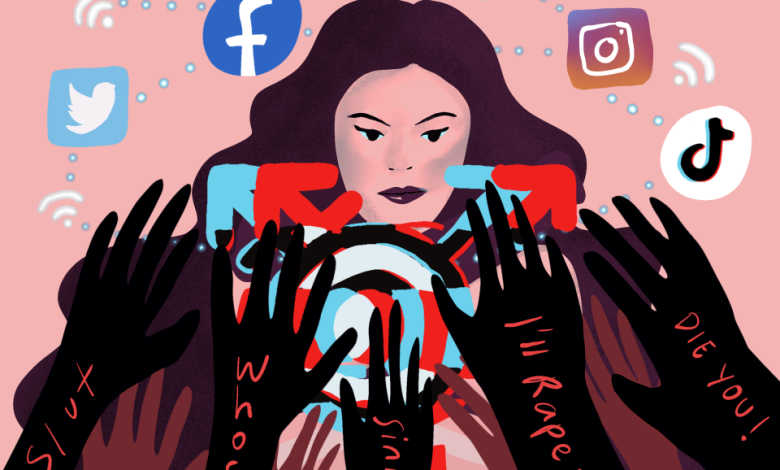
One of the most visible forms of online misogyny is direct harassment. Women who post opinions, particularly on gender, politics, sexuality, or culture, frequently encounter gendered insults rather than engagement with their arguments. Their bodies become topics of discussion. Their sexual histories are speculated about. Their competence is dismissed. In addition, threats of sexual violence appear with disturbing regularity, reinforcing the message that public speech by women invites punishment. This is not random incivility; it is patterned hostility shaped by gender.


However, online misogyny does not operate solely through overt abuse. It also appears through systematic misinterpretation. A woman articulates a structural critique and is accused of attacking men as individuals. A feminist identifies inequality and is reframed as hostile or unstable. As a result, the original issue is displaced, and the woman’s tone, personality, or supposed motives become the focus. In addition, this reframing protects dominant narratives by shifting attention away from power and toward perceived female excess. What appears as a misunderstanding often functions as containment.
Another recurring pattern is coordinated targeting. When women gain visibility online, harassment can intensify rather than dissipate. Posts are shared in hostile spaces to invite collective attack. Employers are contacted in attempts to damage their reputations. Comment sections are flooded with identical talking points. In addition, the cumulative nature of these attacks produces fatigue and fear, signalling to other women that visibility carries risk.
Technological developments have further complicated the landscape. Image-based abuse, once limited to the non-consensual sharing of intimate photographs, now includes AI-generated deepfake pornography and applications that digitally manipulate women’s images without consent. In addition, these tools disproportionately target women and girls, reinforcing the idea that female bodies remain available for public consumption and alteration. The harm is reputational, psychological, and professional.
Online misogyny also embeds itself within humour and entertainment. Memes circulate that reduce women to stereotypes. Influencers construct narratives in which women are framed as manipulative, irrational, or morally suspect. Viral clips mock feminist language as excessive or unnecessary. In addition, repetition gives these portrayals the appearance of consensus. When contempt is packaged as humour, it becomes culturally digestible, and resistance to it is framed as overreaction.
It is equally important to consider how internalised misogyny functions within digital spaces. Women sometimes participate in policing other women, dismissing survivors, or distancing themselves from feminist discourse to gain approval. In addition, online visibility rewards alignment with dominant narratives, creating incentives to reproduce rather than challenge gender hierarchies. This does not suggest equivalence in responsibility but highlights how systemic norms reproduce themselves.
The role of platform architecture cannot be ignored. Social media algorithms prioritise engagement, and content that provokes outrage often attracts high levels of interaction. In addition, controversial or inflammatory commentary about women can attract significant visibility, which platforms interpret as success. This dynamic does not create misogyny, but it amplifies it. The design of digital spaces shapes which voices are elevated and which are marginalised.
The effects extend beyond individual discomfort. Women subjected to sustained online hostility report anxiety, withdrawal, and self-censorship. In addition, when women reduce their participation in digital spaces, public discourse narrows. Fewer perspectives inform debates about policy, culture, and social norms. What appears to be a personal retreat accumulates into structural silencing. The boundary between online and offline life becomes increasingly artificial as digital reputations influence employment, education, and community standing.
Understanding online misogyny, therefore, requires recognising its continuity with longstanding gender hierarchies. The internet did not invent the impulse to discipline women’s speech or to sexualise and discredit them. It provided new tools and new audiences. In addition, the visibility of digital hostility reveals how deeply embedded these attitudes remain. When women are harassed for speaking, when their images are manipulated, when their arguments are distorted, and when their experiences are minimised, the pattern is coherent rather than incidental.
Addressing online misogyny begins with naming it accurately and analysing its forms without dismissal. It requires acknowledging that digital spaces are social spaces, shaped by power, norms, and incentives. In addition, it demands attention to how everyday interactions, platform design, and cultural narratives intersect to sustain hostility toward women. Online misogyny is not an anomaly of internet culture; it is a reflection of enduring inequalities operating through contemporary systems. Recognising that continuity is a necessary step toward challenging it.