5 Books on Women’s Autonomy to Read for Independence
|
Getting your Trinity Audio player ready...
|
Summary: Indeed, Naija Feminists Media celebrates with the nation on its 66th anniversary of independence, but freedom cannot be fully achieved without women’s autonomy. In light of this, NFM examines African literature that celebrates women’s autonomy to join the nation’s celebration. Happy Independence Day, Nigeria!
When Nigeria gained independence in 1960, its women still wallowed in patriarchal structures that did not allow their independence. History books refused to acknowledge their contributions to the country’s freedom. In fact, literature of those times is male-centred, with women as passive characters. Indeed, Naija Feminists Media (NFM) celebrates the nation’s 66 years of independence, but freedom cannot be fully achieved without women’s autonomy. In light of this, NFM examines African literature that celebrates women’s autonomy and joins the nation’s celebration. Happy Independence Day, Nigeria.
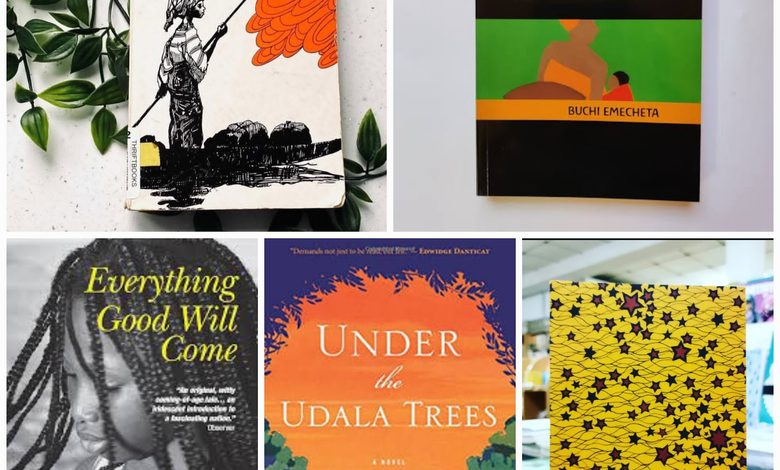
- Half of a Yellow Sun by Chimamanda Ngozi Adichie
Chimamanda’s acclaimed historical fiction, Half of a Yellow Sun, recreates the Biafran War, focusing on women as the moral, economic, and emotional backbones of survival, struggle, contributions, and freedom.
By placing Olanna and Kainene at the centre of the book, Chimamanda argues that a nation’s history cannot be accurately told without women’s perspectives and contributions. At the beginning of the novel, Odenigbo and his male academic peers drink brandy and debate loudly about post-colonial African politics.


They position themselves as the nation’s intellectual saviours. But when the war came, these male intellectuals collapsed. Odenigbo becomes depressed and politically ineffective. Olanna steps up to manage the family’s day-to-day survival. She teaches the children in a makeshift bunker school to preserve education amid chaos. You can read the review here.
Equally, Kainene, her twin, sheds her upper-class lifestyle to run refugee camps, using her sharp business skills to secure food, medicine, and resources where international aid organisations fail. She even risks her life when supply lines are cut to sustain her community.
- Everything Good Will Come by Sefi Atta
Everything Good Will Come celebrates female autonomy as an active, political act. Through the contrasting lives of Enitan and Sheri, Sefi Atta argues that women’s freedom is foundational to a nation’s history and to building a truly democratic nation. She directly links the fight for gender equality with the larger struggle for political democracy in Nigeria. The novel posits that women are not just witnesses to history; they are active agents of political change. For instance, when Enitan’s father, an anti-government lawyer, is jailed, Enitan steps up. She joins pro-democracy protests and uses her legal background to fight state oppression, showing that national freedom requires women’s active mobilisation.
The novel suggests that men’s patriotism often revolves around power, ego, and state control. In contrast, female political engagement in the novel is rooted in human rights, community survival, and justice. By demanding legal reforms and joining human rights organisations, Enitan proves that women’s political autonomy is essential to dismantling corrupt power structures. You can read the review here.
- Under the Udala Trees by Chinelo
Set during and after the Nigerian Civil War (Biafran War), the novel connects the violence of a nation with the violent suppression of queer female identity. By charting the journey of Ijeoma, an Igbo girl who falls in love with women, Chinelo Okparanta asserts that a nation’s true freedom cannot be achieved through mere geopolitical independence; it requires the liberation of its women. Ijeoma’s decision to walk away, leaving a heterosexual marriage in post-war Nigeria, is a profound manifestation of autonomy. The author celebrates this choice as a vital, life-saving act of resistance against living a lie. You can read the review here.
- Joys of Motherhood — Buchi Emecheta
Unlike the previous books, where autonomy is successfully championed, Emecheta’s novel operates as a cautionary critique that demonstrates how the violent intersection of colonialism and indigenous patriarchy strips women of their autonomy. It warns that a nation can never achieve true freedom if it is built upon the sacrifice of its mothers.
Through the life of the protagonist, Nnu Ego, Buchi critiques the lack of women’s autonomy, illustrating that when a woman lives entirely for others, she is ultimately discarded. You can read the review here.
- Efuru by Flora Nwapa
Published in 1966, Flora Nwapa’s Efuru holds a monumental place in literary history as the first internationally published book in English by a Black African woman. In the novel, Nwapa argues that a nation’s true freedom is incomplete without female independence. When Efuru’s first husband abandons her and her second marriage fails, she does not collapse. Instead, she thrives as a highly successful, wealthy trader. She controls her own wealth and uses her financial power to command respect from the entire community. You can read the review here.