|
Getting your Trinity Audio player ready...
|
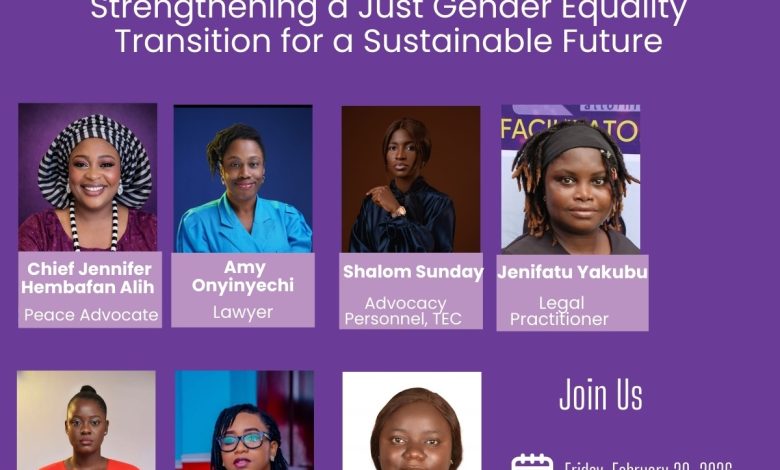
To mark World Day of Social Justice, Naija Feminists Media, in collaboration with Tabitha Empowerment Centre, held an X space titled “Strengthening a Just Gender Equality Transition for a Sustainable Future” on Friday, February 20, 2026, at 5:00 p.m. (WAT). The discussion attracted over 150 listeners who actively participated in the conversation.
Observed annually on February 20, the World Day of Social Justice was established in 2007 and first observed in 2009 to highlight global efforts to address poverty, exclusion, gender inequality, and unemployment, while promoting human rights, fair income distribution, and inclusive social protection systems.
A gender equality transition refers to the structural and societal changes needed to dismantle harmful gender norms, power imbalances, and discrimination, ensuring equal rights, opportunities, safety, and representation for all, particularly in economic participation, leadership, and access to justice.
The conversation featured experts and professionals who unpacked structural inequalities, policy gaps, and pathways toward inclusive and sustainable futures. Speakers included Chief Jennifer Hembafan Alih, a community development strategist and peace advocate; Dorcas Bello, a journalist; Jenifatu Yakubu, a legal practitioner; Grace Davou, advocacy personnel at Tabitha Empowerment Center (TEC); Gladys Emmanuel, advocacy officer and in-house lawyer at TEC; Shalom Sunday, assistant advocacy personnel at TEC, Kano State; and Amy Onyinyechi, a lawyer and development sector professional.

Grace Davou explained gender equality from an educational perspective, noting that the transition goes beyond numbers to focus on the quality of education for girls. She emphasised the importance of safe school environments, leadership education from an early age and a sensitive curriculum that equips girls to face future challenges. She highlighted practical measures such as the presence of school counsellors, suggestion boxes, safe toilets and access to period materials to ensure girls feel safe and confident enough to report problems without fear or stigma.
Chief Jennifer Alih noted that one of the biggest barriers to gender equality is deeply rooted social conditioning and inherited beliefs about gender roles. She explained that economic dependence limits women’s choices and prevents them from achieving their full potential. According to her, gender equality will remain only a conversation until it becomes a lived reality, and society must provide opportunities for girls and women to thrive.
Shalom Sunday added that patriarchal norms and structural inequalities, including political and financial barriers, make it difficult for women to succeed. She emphasised the need to educate girls and women to challenge societal conditioning and expand their opportunities.
Dorcas Bello focused on the role of media in shaping societal perceptions, explaining how social media, films, and advertisements can perpetuate stereotypes about women. Gladys Emmanuel stressed the importance of community sensitisation, citing a 2021 case in which a young girl, aware of gender-based violence protocols, safely reported being raped by a law enforcement officer, resulting in justice being served. She said such progress would not have been possible without community awareness campaigns.
Amy Onyinyechi noted that gender equality advances most effectively when efforts move from short-term projects to long-term systemic change. She emphasised that funding and donor support should strengthen institutions rather than individual activities and support legal and policy reforms, including harmonising federal laws at the state level. She added that women’s economic empowerment must go beyond skills training and livelihoods to achieve meaningful transformation.
Chief Jennifer concluded that women must support one another by promoting each other into leadership and political positions rather than relying solely on government action. She noted that a just gender equality transition means moving from intention to inclusion in ways that are both fair and practical.
The discussion highlighted why gender equality must remain central to social justice efforts, examined the barriers that exclude women from progress, and explored what a truly just and inclusive transition should look like in building sustainable societies.