|
Getting your Trinity Audio player ready...
|
The Federal Government has announced plans to establish at least one Sexual Assault Referral Centre (SARC) in each of Nigeria’s 774 local government areas, describing the existing 52 centres across the country as inadequate to meet the needs of survivors of sexual and gender-based violence.
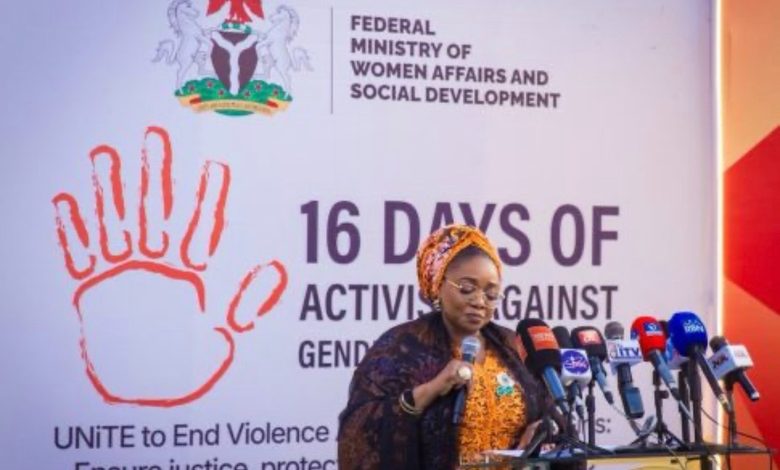
The Minister of Women Affairs and Social Development, Imaan Sulaiman-Ibrahim, disclosed this on Monday during the 2026 Ministerial Press Briefing to commemorate the International 16 Days of Activism Against Gender-Based Violence at the ministry’s headquarters in Abuja.
Sulaiman-Ibrahim said the ministry was working with state governments to expand access to medical, psychosocial and referral services for survivors, noting that the current number of centres was insufficient for a country with a population of over 240 million.
“However, for a nation of over 240 million people, 52 centres are grossly inadequate. We are actively working with State Governments to ensure that at least one Sexual Assault Referral Centre is established in every Local Government Area across the country,” she said.

She added that the ministry would continue to advocate for the eventual establishment of referral centres in every ward under the Renewed Hope Social Impact Intervention 774 framework.
The minister also announced that Nigeria’s National Gender-Based Violence Electronic Dashboard and Situation Room was now operational, describing it as a major development in strengthening real-time data management, coordination and accountability in the country’s response to gender-based violence.
She credited the United Nations Population Fund (UNFPA) for supporting the establishment of the platform.
Addressing the prevalence of gender-based violence in Nigeria, Sulaiman-Ibrahim said nearly one in three Nigerian women aged 15 to 49 had experienced physical or sexual violence.
She also cited over 27,000 documented sexual and gender-based violence cases in recent reporting cycles, alongside millions of unreported incidents.
According to her, gender-based violence costs Nigeria an estimated 1.5 per cent of its Gross Domestic Product, equivalent to approximately $3bn annually through lost productivity, healthcare expenses and disrupted livelihoods.
The minister said the government was also strengthening legal and institutional frameworks to address violence against women and children.
She disclosed that the Child Rights Act of 2003 had been domesticated across all 36 states, while the Violence Against Persons (Prohibition) Act of 2015 had been domesticated in 35 states.
Sulaiman-Ibrahim further announced the commencement of a review of the National Gender Policy (2021–2026), following the completion of its end-term review and the launch of the Nigeria Gender Profile.
She called on development partners, civil society organisations and other stakeholders to participate in the review process, adding that the ministry had also developed, reviewed and validated more than 38 policy instruments, standard operating procedures and specialised frameworks to strengthen protection standards nationwide.
On child protection, the minister highlighted the development of the National Boy Child Policy, describing it as a significant step towards addressing challenges confronting boys, including school dropout, substance abuse, street vulnerability and social neglect.
She said protecting and empowering boys alongside girls was necessary to prevent cycles of intergenerational violence and promote safer communities.
The minister also referenced the National Strategy and Costed Action Plan on Ending Child Marriage in Nigeria (2025–2030), which was endorsed by the Federal Executive Council on October 28.
She added that the council had approved the National Policy on Menstrual Health and Hygiene Management (2026–2030) and the National Care Policy and Implementation Plan (2026–2030).
According to her, the policies are expected to promote menstrual dignity, support local manufacturing of sanitary products and recognise the economic value of unpaid care work predominantly undertaken by women.
Sulaiman-Ibrahim also highlighted the government’s economic empowerment programmes for women, including initiatives targeting access to clean energy, digital literacy, financial inclusion, agriculture and entrepreneurship.
She said the Renewed Hope Social Impact Intervention 774, a nine-pillar framework covering all 774 local government areas, was designed to reach 50 million women, children and vulnerable Nigerians.
Under the framework, the ministry plans to empower five million women through the Nigeria for Women Programme Scale-Up, onboard 10 million women onto the Happy Woman App and train five million women in digital skills through the Digital Harmony initiative.
The minister further disclosed that the government was implementing Nigeria’s Third National Action Plan on Women, Peace and Security, aimed at expanding women’s participation in conflict prevention, peacebuilding and recovery.
She called for increased women’s representation in governance, expressing support for President Bola Tinubu’s proposed Reserved Seats for Women constitutional reform.
As part of activities marking the 2026 16 Days of Activism, Sulaiman-Ibrahim said the ministry and its partners had planned a nationwide No Tolerance Advocacy Walk, a town hall meeting with Nigerian women ahead of the 2027 general elections, the Sixth Annual Forum on Women, Peace and Security, and the Second National Summit on Menstrual Health and Hygiene Management.
The activities will also include interfaith engagements, with special church services and Jumu’ah prayers intended to mobilise religious leaders and congregations against gender-based violence.
The International 16 Days of Activism Against Gender-Based Violence runs annually from November 25 to December 10, culminating in Human Rights Day.
The 2026 global theme is “UNiTE to End Violence Against Women and Girls: Ensure Justice, Protect Survivors, End Impunity.”
The minister urged government institutions, civil society organisations, traditional and religious leaders, the media and the entertainment industry to strengthen collaboration in addressing violence against women and girls.
She said the campaign must extend beyond its 16-day observance, stressing that sustained action was necessary to ensure survivors receive justice and perpetrators are held accountable.