Inside Nigeria’s Telegram Sex Trade: Paid Access, Blackmail and Cross-Border Recruitment
|
Getting your Trinity Audio player ready...
|
“To join, you must pay ₦15,000 first.”
That was the response an administrator of a Telegram group with more than 11,000 members gave this reporter after she inquired about joining.
The payment was not for a product or subscription. According to the administrator, it was the fee required before prospective members could advertise commercial sexual services in the group.
Over weeks, this reporter observed more than 100 Telegram groups where commercial sexual services were openly advertised, women paid administrators to access potential clients, and recruiters promised opportunities as far away as Ghana and other countries.


The groups contained thousands of members and featured posts from women advertising sexual services, as well as men seeking paid sexual encounters.
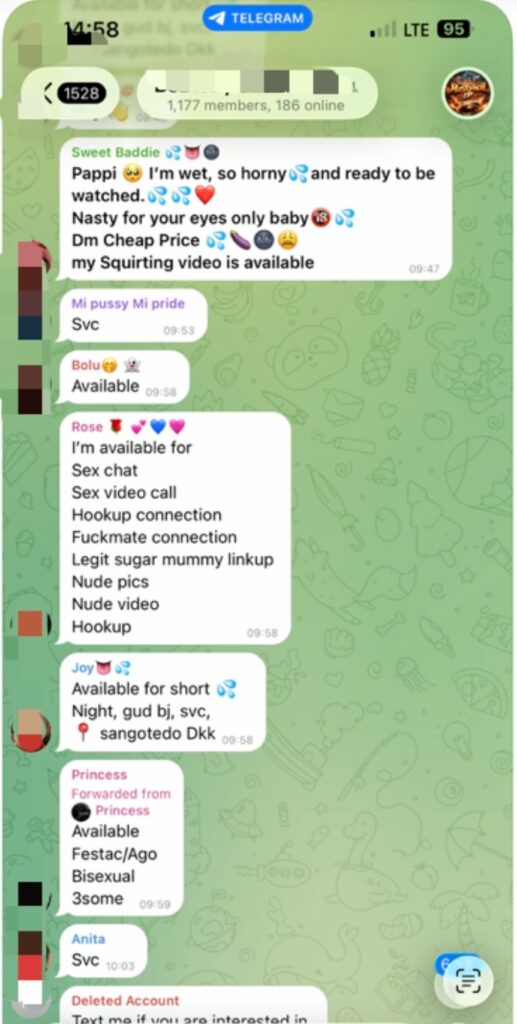
A screenshot of one of the sexual advertisements.
According to Abdulwasiu Olokooba, a legal practitioner and digital rights advocate, Prostitution is not legalised or regulated as a profession in Nigeria, but the legal position varies by region. In much of Southern Nigeria, private consensual sex work by adults is not expressly criminalised, although activities such as public solicitation, procuring, pimping and brothel-keeping are offences. In the Northern states and the FCT, prostitution is more directly criminalised under Penal Code provisions.
This reporter also observed posts from users offering to become “sex slaves” in exchange for financial support, while others sought “sugar mummies” willing to provide money, cars, or accommodation. Some users also advertised explicit photos and videos for sale.
It was observed that users in Telegram groups where commercial sexual services were openly advertised frequently communicated using coded terms and abbreviations that may be unfamiliar to the general public.
For instance, “ST” referred to short time, while “OVN” meant overnight. Other commonly used terms included “BJ” for blow job, “SVC” for sex video call, and “HK” for hookup. The groups also used abbreviations such as “FFM/MMF” to describe threesomes involving either two women and one man or two men and one woman, while “FFMM” referred to group sexual encounters involving four people, such as two women and two men or three men and one woman.
This investigation also observed that users in Telegram groups where commercial sexual services were openly advertised operated private channels that required prospective subscribers to pay a fee before gaining access.
Within these private channels, subscribers were offered sexually explicit content, including nude images, lesbian videos, videos of masturbation, sex videos, and recordings of sexual video calls.
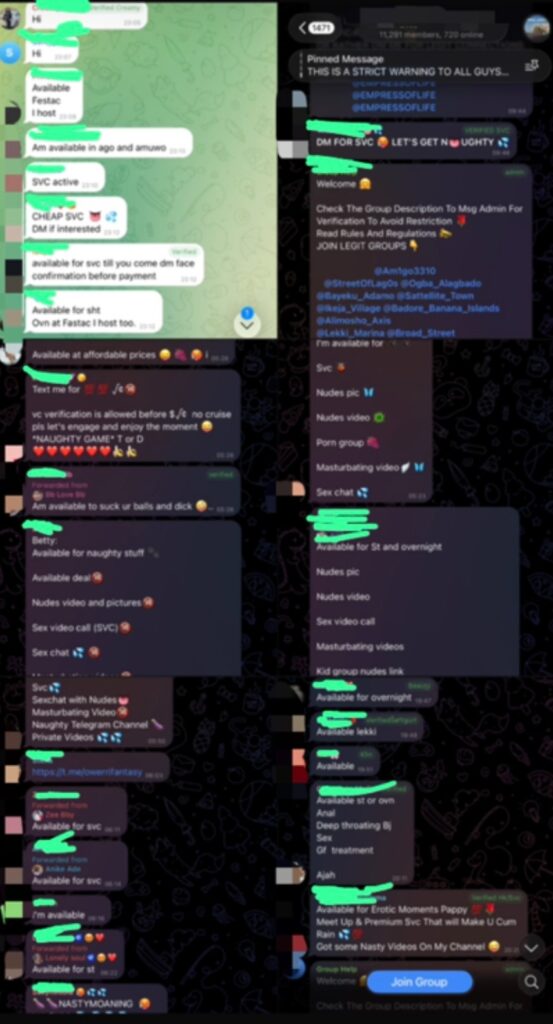
Different images showing advertisements of sexual activities openly
In one Telegram group, “Lekki Chevron to Ajah,” this reporter contacted an administrator while posing as a prospective member. The administrator stated that a ₦15,000 membership fee was required before access to the group would be granted and before members could advertise their services. At the time of observation, the group had more than 11,000 members.
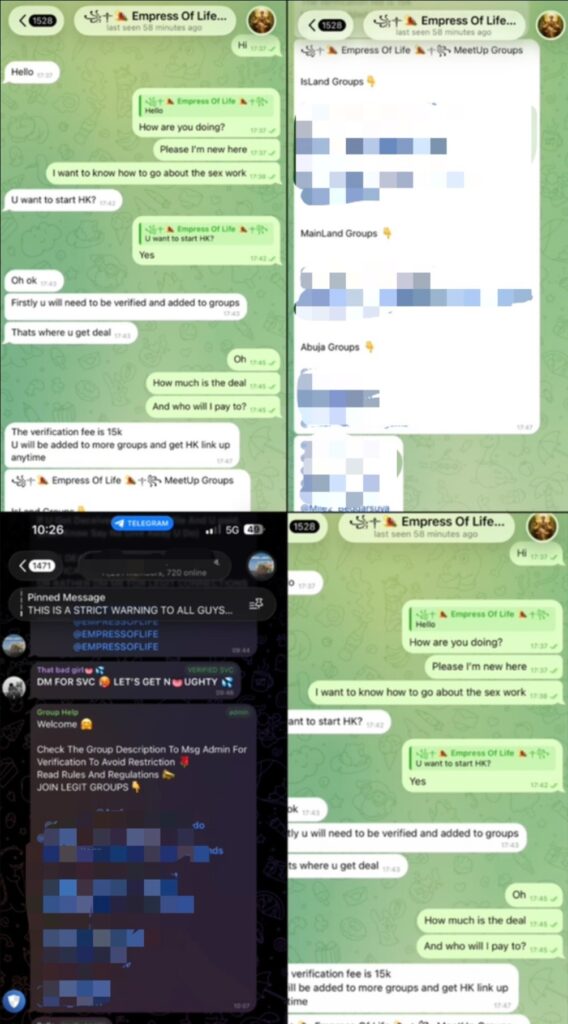
Image showing conversation between the admin of the group and the reporter
Interviews with women using the platform, corroborated by this reporter’s observations of several Telegram groups, indicate that women are often required to pay administrators before they can advertise their sexual services.
Anthonia Ukechukwu (not her real name), a 25-year-old from Lagos, said she was introduced to Telegram by a friend. She had previously worked as a lash technician before turning to commercial sex work through the platform.
“I joined Telegram through a link my friend shared with me. I joined the Telegram groups because it’s a comfortable place for me to find clients easily. Clients book me through my advertisements in the different groups I’m in. Sometimes I host them, while other times they invite me to their place or book a hotel,” she said.
According to Anthonia, women are required to pay administrators before they can advertise their services in many of the groups.
“Before we can start advertising what we do, we have to pay a certain amount to the admin. I paid ₦4,000 to one admin, but it took days before he added me to the group,” she said.
She alleged that her experience on the platform has also exposed her to harassment and abuse.
“I have been blackmailed twice. Some people posted my pictures, claiming that I don’t really perform well, and sometimes they body-shamed me, saying my body is not banging,” she said.
Anthonia said she had considered leaving both the Telegram groups and sex work but claimed that an administrator discouraged her from doing so.
“Sometimes I have thought about leaving the group and even leaving the sexual work completely, but the admin threatened that if I left, it could expose what they are doing in the group,” she said.
She added that she once reported an administrator to Telegram over the alleged threats but said no action was taken.
“There are so many fake job offers on Telegram. If one is not careful, he or she will be scammed multiple times,” she added.
Telegram claims it prohibits users from using the platform for illegal activities, including scams and the distribution of illegal pornographic content via publicly accessible channels and bots. The company says users can report illegal content through its in-app reporting tools or by email, and that it reviews reports and removes content found to violate its rules or applicable law
Gobir Abdulazeez, an IT expert, acknowledged that Telegram has features such as groups and channels that enable criminal networks to organise illicit activities, especially towards women. It allows anyone to create public channels and groups that can easily be found through search or shared via links.
These criminal networks were able to facilitate such illicit services because, unlike WhatsApp and Signal, which are centred around private contact and smaller communities, Telegram can accommodate hundreds of thousands of members, making it easier to reach large audiences to find new victims or customers.
Ayo (not her real name), a 27-year-old from Lagos, has been advertising her sexual services on Telegram for the past year. She said she has repeatedly been left stranded after travelling to meet clients who never showed up.
According to Ayo, the services she advertises include body massage, “BJ,” “ST” (short time), and “OVN” (overnight). She said clients who book her for ST or OVN expect a range of sexual services during the agreed period.
“I started doing this sexual work because I was in debt. I can’t disclose how the debt came about because it’s a personal issue. I also have responsibilities, especially taking care of my younger siblings,” she said.
Despite the income, she said the work has exposed her to repeated humiliation and financial losses. She recounted several occasions when clients gave her an address, only to switch off their phones or refuse to answer her calls after she arrived.
“Transport wasted, efforts wasted, and the time I could have used to meet another serious client who was ready to pay,” she said.
Another woman from Abuja, who requested anonymity, said she has paid more than ₦20,000 to become a verified member of different Telegram groups where she advertises her sexual services.
She alleged that even after paying, some administrators continued to demand more money whenever they noticed that clients were responding positively to her advertisements in the group.
“I started doing sexual work on Telegram less than a month ago, and the services I offer are ST and OVN. ST is ₦40,000, while OVN is ₦80,000.
“I’m not here permanently. I’m only doing this to raise money for my hairstyling business. Once I reach my target of ₦1.5 million to secure a shop and accommodation, I will stop.”
She said financial pressure has kept her from leaving despite the challenges.
“I can’t just stop because of the money I need to raise; what I face in this sexual work is too much, from extortion to bullying and many other things I can’t disclose to you,” she lamented.
The financial incentives advertised in these Telegram groups stand in stark contrast to the economic realities facing many Nigerians. Nigeria’s monthly minimum wage is ₦70,000, while many workers in the informal sector earn even less.
Against this backdrop, women interviewed for this investigation said they could charge between ₦40,000 for a short-time (ST) booking and ₦80,000 for an overnight (OVN) booking, while some group administrators charged between ₦4,000 and ₦20,000 for membership or verification fees.
Several women said the prospect of earning in a single encounter what many Nigerians earn in weeks or even a month made the platform difficult to ignore despite the risks of blackmail, extortion, and exploitation.
An expert confirmed that the most common offences accompanying these activities are blackmail, for which they have access to. Intimate pictures of the client are shared, and they are asked to pay a certain amount of money; otherwise, they will release their pictures or videos.
During this investigation, this reporter observed a post in a Telegram group from an account identifying itself as “Chioma Jossey,” advertising opportunities for women to travel to Ghana for commercial sexual services.
Posing as a prospective recruit, this reporter contacted the account. In messages reviewed by this reporter, the account claimed it would arrange road transportation to Ghana and provide accommodation and feeding until the women began meeting clients.
According to the account, clients could be sourced through Telegram, “coded runs” websites, or by attending clubs.
The account also sought to persuade this reporter by describing the potential financial returns. It claimed that 1,000 Ghanaian cedis was equivalent to about ₦127,000 and said women providing overnight sexual services could charge at least 2,000 Ghanaian cedis.
The account further claimed that the journey to Ghana by road takes just one day, that prospective recruits did not need a passport or visa, and that the cost of the trip could be repaid after one month and two weeks in Ghana.
“You are not the first person that I have transported to Ghana”, he claimed
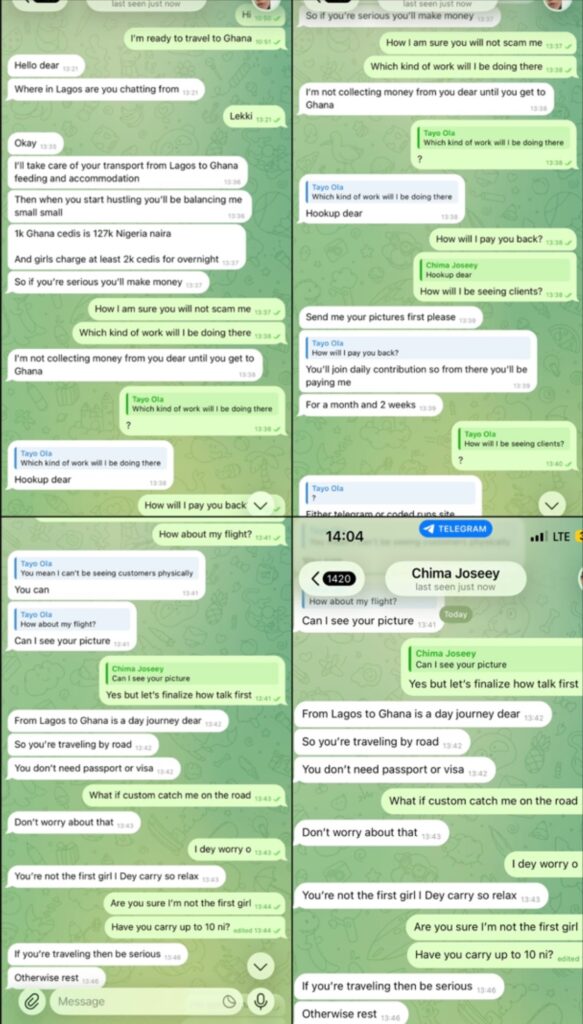
Image showing the conversation between Chioma Jossey and the reporter
According to a report on the Punch, the National Agency for the Prohibition of Trafficking in Persons has received 12 victims of human trafficking repatriated from Ghana. Also, according to a UNODC Report, the most common form of human trafficking (79%) is sexual exploitation
The expert said most recruitment frequently begins with deceptive advertisements promising legitimate employment, modelling opportunities, hospitality jobs, or travel opportunities. Communication usually progresses gradually to build trust before revealing the true nature of the activity. Client verification may involve referrals from existing members, proof of payment, identity confirmation, or recommendations from trusted contacts within the network. These practices are designed to reduce the risk of infiltration by law enforcement.
During this investigation, this reporter also identified a Telegram account operating under the name “LaraQueen,” which advertised a service connecting people for sexual encounters, companionship, friendship, and relationships.
In a message reviewed by this reporter, the account stated:
“If you are a Nigerian in the diaspora, you don’t need to go far. I created this platform purposely because of you. I know how deserted and isolated that place is. It could be so lonely that you feel you’re in this world alone. I am doing this to connect people together for sex, companionship, friendship, relationship and several other things.”
The account also stated that its charges varied depending on the prospective member’s country of residence and the currency used.
In messages reviewed by this reporter, the account explained that Nigerians in the diaspora would be charged in pounds (£), U.S. dollars ($), or euros (€), depending on their location. It stated that the fee for “hookups” was 75, “fuckmate” services cost 100, while those seeking a “sugar mum/dad” arrangement would pay 300, with an initial payment of 150.
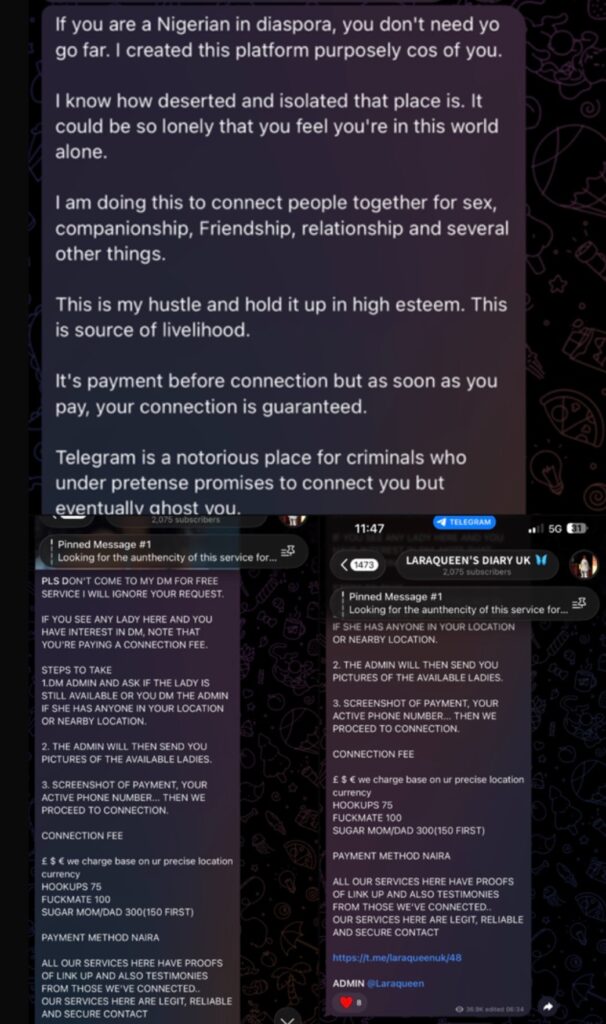
Pictures of LaraQueen advertising connecting people for sexual encounters
Abdulazeez said these networks often attempt to reduce their visibility by operating through private or invitation-only groups, frequently changing usernames or channels, using multiple accounts, relying on encrypted communications where available, and deleting messages or accounts after transactions. They may also use cryptocurrency or intermediaries for payments and encourage communications to move across multiple platforms to make investigations more difficult.
Abdulwasii Olokooba said Telegram’s large group capacity, anonymous usernames, private channels, file-sharing capabilities, and comparatively limited content moderation have made the platform attractive to criminal networks seeking to recruit victims, coordinate illicit activities, and distribute exploitative content. While he stressed that these features are not unlawful in themselves, he said they can be abused where adequate safeguards are lacking.
He noted that although privacy is protected under Section 37 of Nigeria’s 1999 Constitution, it is not absolute.
According to him, platforms should preserve users’ privacy while adopting proportionate safeguards, including effective reporting systems, metadata analysis, trusted flagger mechanisms, and cooperation with lawful investigations. He added that end-to-end encryption makes proactive detection of criminal activities more difficult, forcing investigators to rely heavily on victim reports, digital forensics, metadata, and court-authorised investigative measures.
While Nigeria has laws such as the Cybercrimes (Prohibition, Prevention, etc.) Act, the Violence Against Persons (Prohibition) Act, the Child Rights Act, and the Nigeria Data Protection Act, he said stronger enforcement, clearer intermediary liability provisions, improved cross-border cooperation, and greater institutional capacity are needed to address digital exploitation.
He also called on Telegram to strengthen its content moderation and reporting systems, while urging regulators and law enforcement agencies to enhance platform accountability, digital forensic capacity, and international collaboration to combat online exploitation.
Responding to findings, Women’s rights activist Jenifatu Yakubu argued that the growing use of Telegram to facilitate commercial sexual services cannot be separated from the broader realities of poverty, gender inequality, and limited economic opportunities. She said many women enter the digital sex trade not out of genuine freedom of choice, but as a means of survival in the face of financial hardship, making them particularly vulnerable to exploitation.
She stressed that it is important to distinguish between women independently advertising sexual services and those subjected to coercion, extortion, blackmail, or trafficking.
According to her, platforms such as Telegram can become tools for exploitation when anonymous administrators and users are able to intimidate, threaten, or financially exploit women with little accountability, exposing them to significant physical and psychological harm.
She called for legal and policy reforms that prioritise prosecuting traffickers, extortionists, and others who profit from exploiting women rather than criminalising women trying to survive.
She also urged technology companies, law enforcement agencies, and policymakers to strengthen protections for women while addressing the underlying drivers of exploitation, including poverty, systemic misogyny, and gender inequality.
As online-facilitated exploitation continues to evolve, the cybercrime expert advised Nigerians, particularly women seeking employment opportunities online, to approach unsolicited job offers with caution, especially those promising unusually high earnings with little or no experience or requesting secrecy.
He urged people to independently verify the identity of recruiters and the legitimacy of companies before engaging with them, and to avoid sharing personal documents, banking information, or intimate photographs with unknown individuals. He also encouraged victims or those who suspect criminal activity to report such accounts to the platform and notify relevant law enforcement authorities.
He further called on law enforcement agencies to strengthen their digital investigation capabilities and deepen collaboration with international partners, noting that many of these networks operate across borders. He also urged regulators to develop clearer legal frameworks that support lawful investigations while safeguarding privacy and human rights, and emphasised the need for sustained public awareness campaigns to educate people about online recruitment scams, digital exploitation, and the tactics used by criminal networks.
Telegram and the National Agency for the Prohibition of Trafficking in Persons (NAPTIP) declined to comment on the findings of this investigation despite multiple requests.