|
Getting your Trinity Audio player ready...
|
By: Nusiroh Shuaib
Summary: In celebration of International Women’s Day, Naija Feminists Media highlights African feminist authors who used their writings to challenge patriarchy, dismantle the relegation of women to shadow characters by male authors, and ultimately shatter patriarchal structures.
In early African literature, stories focused on men and patriarchy. The women were pushed to the background, serving as props for men to demonstrate authority, and were discarded. However, pioneering authors like Flora Nwapa, Buchi Emecheta, Mariama Ba, and Ama Ata Aidoo became defiant voices who challenged and criticised patriarchal writings, society, and structures. These writers didn’t just tell women’s stories; they dismantled the single narrative and reconstructed the literary landscape from the ground up to reflect the nuanced realities of womanhood while shattering the patriarchal and colonial structures that sought to silence them.
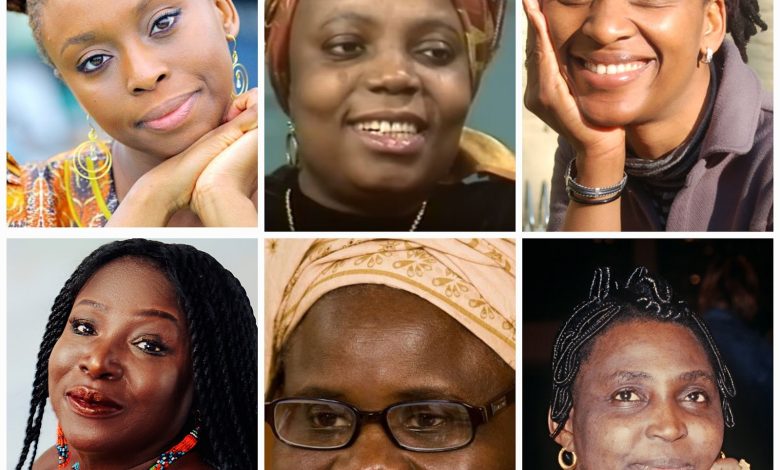
On the flip side, they paved the way for 21st-century renowned authors like Chimamanda Ngozi Adichie, Bisi Adjapon, Chika Unigwe, Oyinkan Braithwaite, and Sefi Atta. On this International Women’s Day, Naija Feminists Media highlights seven of these African Feminist authors.


7 Celebrated African Feminist Authors
- Flora Nwapa
Flora Nkiru Nwapa, also known as “Mother of modern African literature,” was a Nigerian author and a forerunner to a generation of African women writers. She used her writings to correct the “misrepresentation” of African women in the works of male authors like Chinua Achebe, who often portrayed women as submissive or secondary.
As the first African woman novelist to be published in the English language in Britain, the author achieved international recognition with her first novel, Efuru (1966). Her other novels include: Idu (1970), Never Again (1975), One is Enough (1981), Women are Different (1986), This is Lagos (1971), Wives at War (1980), and Cassava Song and Rice Song (1986).
She is also the author of several children’s books. As a pioneering author, Flora’s books primarily centred on African women’s quest for identity, female solidarity, and survival in a patriarchal world. Academics and readers agreed that her books corrected the one-dimensional narratives of women in male-authored literature by showing them as industrious, resilient, and multifaceted. Read the book review here.
- Buchi Emecheta
As a renowned Nigerian author of several books, Buchi Emecheta first received recognition for her 1974 autobiographical novel, “The Second Class Citizen.” Drawing from her experience of a violent marriage, Buchi’s writing focuses on the lived experiences of African women, prioritising their resilience, economic independence, and navigation of traditional patriarchal structures. As a single mother of five children, she earned a B.Sc. (Hons) in Sociology from the University of London in 1972 and later achieved a PhD in social education from the same university in 1999. While working as a librarian at the British Museum and writer at night, Buchi authored more than 20 books, including “Joys of Motherhood (1979), Kehinde (1994), The Bride Price (1976), The Slave Girl(1979) and others. Read the review here.
- Ama Ata Aidoo
Professor Ama Ata Aidoo was a Ghanaian renowned playwright, novelist, and poet. Her writings challenged patriarchal norms and gave voice to the modern African woman. She was of the first generation of African women writers and philosophers who cleared the pathway for and continue to shape the thriving global community of women authors that African literature and African Studies have today. Prof. Aidoo once served as Secretary for Education in Ghana from 1982 to 1983, and was the first woman to hold that position. As a feminist writer, she argued that feminism was not “un-African,” noting that she learned her first feminist lessons in Africa from the independent-minded women who raised her. Her books often explored themes of patriarchy, identity, female solidarity, colonialism, and societal expectations. Read the book review here.
- Mariama Ba
Mariama Bâ was one of the pioneers of African women authors and a feminist. She is a Senegalese writer who used her writing as a weapon to challenge the deep-seated gender inequalities in post-colonial Senegalese society.
Her feminism was not just a literary style but a political mission to remove the status quo that subjugated women. Her debut novel, “So Long A Letter,” won the first Noma Award for Publishing in Africa in 1980. Mariama published two books during her lifetime, both of which deeply explored the patriarchal society of Senegal. You can read the review here.
- Chimamanda Ngozi Adichie
Chimamanda Ngozi Adichie is a prominent 21st-century literary figure and feminist author. Her works, including fiction, essays, and public talks, focused on the independent existence of women, patriarchy, identity and rejection of feminism lite. She follows the footsteps of Flora Nwapa and Buchi Emecheta; therein, she portrays her female characters as autonomous, resilient, independent, and free-minded individuals. She has authored 11 books, including Purple Hibiscus (2003), Dream Count (2025), Americana (2013), and Half of A Yellow Sun (2009). The established writer has received numerous awards for her literary prowess. You can read her book review here.
- Chika Unigwe
Chika Unigwe is a widely recognised 21st-century novelist. She uses her work, mostly fiction, to challenge the objectification of women and dismantle patriarchal structures in both African and European contexts. Chika’s novels are characterised by themes of patriarchy, identity, female resilience, grief, trauma, and societal expectations.
Her books include: Grace (2026), The Middle Daughter (2023), On Black Sisters’ Street (2009), Night Dancers (2012), and others. She won the Nigeria Prize for Literature in 2012 for her novel On Black Sisters’ Street and was selected for the Hay Festival’s Africa39 list of 39 Sub-Saharan African writers aged under 40 in April 2014.
She is on the Board of Trustees of pan-African literary initiative Writivism, and set up the Awele Creative Trust in Nigeria to support young writers. Read the book review here.
- Bisi Adjapon
Bisi Adjapon is a Ghanaian feminist writer whose debut novel, “The Teller of Secrets,” boldly unleashed feminist awakening. While an established author of two novels, “The Teller of Secrets and Daughters in Exile,” the writer critiques the notion that marriage is the ultimate goal for a woman.
Both books drive deeper into themes of female sexuality, patriarchy, feminism, motherhood, religion, and traditions. In 2023, Daughters in Exile was named Best Book by The New Yorker and NPR and The Teller of Secrets was named a best book by the American Library Association (ALA), The Washington Post, The Boston Globe, and Essence. Read the book review here.