|
Getting your Trinity Audio player ready...
|
Today, Saturday, June 20, 2026, Ekiti State will go to the polls to elect a new governor. Among the thirteen candidates cleared to contest the election, none of them is a woman. The Independent National Electoral Commission (INEC) final candidate list shows a governorship race that is a contest between men.
Often, women appear on the ballot only as running mates, and in this case, four of them are nominated for the deputy governorship slot across the thirteen parties. This is not an accidental irregularity; it is a systemic one.
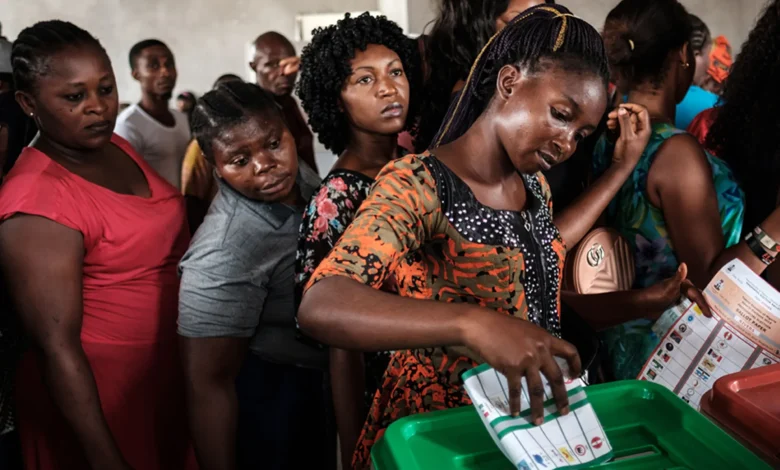
INEC says 1,059,360 people are registered to vote in today’s election, which is an increase of roughly 66,000 voters since the last governorship contest. Women make up 51.2 per cent of that register, men 48.8 per cent. Despite women forming the majority of voters, they are entirely absent from the governorship ballot.
The contradiction is difficult to ignore. Women are expected to mobilise, campaign, canvass support, vote, and legitimise the democratic process. But when it comes to occupying the political office in the state, they remain excluded from consideration. The result is an election in which women are present everywhere except where power is being contested.


On June 11, INEC Chairperson Prof. Joash Amupitan, SAN, addressed political parties, security agencies, traditional rulers, civil society organisations and the media at a Stakeholders’ Forum in Ado-Ekiti. He assured them that every valid vote will count and that the Commission was ready to deliver a credible, transparent and inclusive election across the state’s 16 Local Government Areas, 117 Registration Areas and 2,445 Polling Units.
But how fair is an election in which women are structurally excluded from the gubernatorial race? The Commission’s commitment to inclusion focused on voter participation rather than candidate representation. While ensuring access to voting is essential, it does not answer the question of why half of the population remains largely excluded from the offices being contested.
Long before voters arrive at polling units, women face barriers that limit their ability to emerge as candidates. These barriers include expensive nomination forms, unequal access to campaign financing, political violence, party gatekeeping and the lack of internal party mechanisms designed to increase women’s participation. INEC is equipped to address some of these structural reforms by mandating parties from the grassroots level to produce gubernatorial candidates that is inclusive of women.
Stakeholders at Naija Feminist Media’s webinar have recommended that increasing women’s representation requires more than encouraging women to run for office. It requires dismantling the systems that prevent them from emerging as candidates in the first place.
Central to their representation are policy-driven mechanisms such as reserved seats and gender quotas to improve representation ahead of the 2027 general elections. Civic-tech advocates have also pointed to the gap between Nigeria’s stated ambitions and its electoral reality.
Bukky Shonibare, Executive Director of Invictus Africa, has noted that reaching the 35 per cent affirmative action benchmark for women’s representation would be a significant milestone for the country, one that would signal Nigeria’s commitment to gender equality and build confidence among women and girls watching the political system from the outside.
Ekiti’s 2026 ballot moves the state no closer to that benchmark. INEC’s sexist gubernatorial election will quietly reproduce the power dynamics that keep women oppressed, an election that once again produces a male leader and excludes women.