How Nigerians Judged The Book ‘Husband Is Useless’ by Its Cover
|
Getting your Trinity Audio player ready...
|
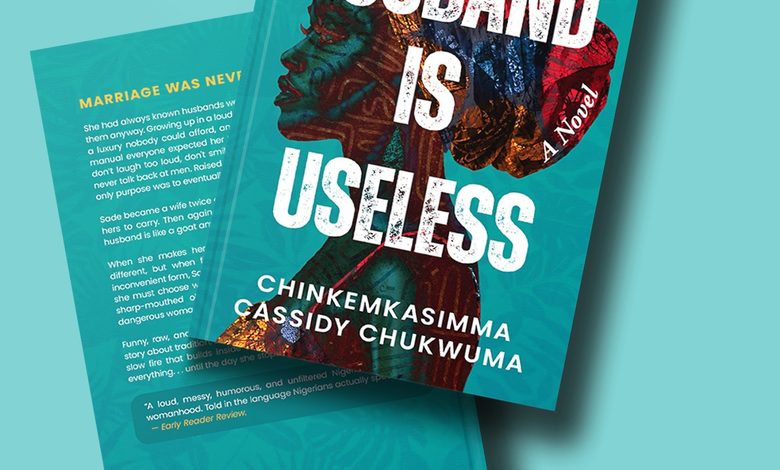
Chinkemkasimma Cassidy Chukwuma, a Nigerian writer, recently announced her debut novel on her social media page with the book’s cover photo captioned “I wrote a book,” and she could not have anticipated that the title alone would lead to a discourse cycle spanning Facebook, X, and Instagram.
The reactions were not, in any meaningful sense, a conversation about the novel. They centred on the four words printed across a woman’s face on the book’s cover: “Husband Is Useless.”
The ongoing controversy reveals who gets to make a claim in Nigerian public discourse, and who is presumed to be speaking only for or against a category of person rather than telling a story.
The most repeated objection in the comment threads was not really about this book at all. It was a genre complaint. Comments like “You women never write books about how to make money, build yourself, grow your career, or improve your life,” and “It’s always how to hate men, how to deal with men, how to survive men, how husbands are useless,” reduced women’s creative exercise to a charade that’s always centered on men.


However, the book, according to the synopsis shared by a reader who identifies as @OtPersimmon on X (formerly Twitter) — is not really about men being useless, nor is it the author’s personal opinion. The story follows Folasade Mary-Margaret Ajani, a woman whose complicated relationship with the idea of marriage begins in childhood and carries her through two marriages across several decades, moving between Lagos and Anambra State from the late 1980s onward.
Sade has always believed that husbands are useless. The contradiction at the heart of the story is that she eventually finds herself married twice. The novel is less interested in whether she is right than in where that belief came from, and what it costs her.
Considering the plot, the title should not be made into a subject of argument, because it merely reflects a character’s wound. It is not the author’s thesis but the main character’s own, and the book is not even a confirmation of belief, it’s an interrogation.
A book should not be judged by its cover, but Nigerians threw that practice away in this case. A Facebook user who identifies as Prof. Jerry, who claimed to have read it, said it’s as useless as the title claims husbands to be. Yet the commentator made no reference to the substance of the book.
His argument was grounded superficially in the title alone. It is worth examining closely, because it performs the very failure it accuses the author of committing. He begins by defining “useless” neutrally, as merely “not useful,” and insists that calling something useless is not an insult but “a perspective of reason that needs to be backed up with facts and reason, rather than emotions.” He then argues that Chinkemkasimma is “rather emotional about her assertions rather than being logical,” and that her opinions are “subjective and not objective.”
This is a claim about the title. It is not a claim about the main character, Sade, her two marriages, her childhood, or the forty-year arc the novel is reported to trace. A reader who had genuinely engaged with a coming-of-age narrative about the origins and cost of a belief would have something to say about the belief’s origin or its cost. Prof. Jerry has nothing to say about either, because his real objection was never to the book. It was to the title.
Two days into the discourse cycle, a man using the handle @onbetwist_ posted his own version: a mock cover titled “Wife Is Useless,” styled identically to the original, captioned “I wrote a book” in direct imitation of Chinkemkasimma’s post.
This act demonstrates how women’s genuine portrayal of their art can be made into a joke. A woman wrote a book that reflects a belief and a storyline that explains where that belief came from. Yet a man made a meme in response.
Chioma Ikedum, who offered the sharpest response of the entire discourse, said: “Lol. Read the book first! Do you remember ‘Our Husband Has Gone Mad Again’ by Ola Rotimi? The husbands were not mad naa. It’s just a hook to get you to read it.”
Ola Rotimi’s 1966 play uses exactly the same rhetorical device: a title that states something no reader is meant to take as literal, universal truth, functioning instead as an entry point into a specific, particular story. Nobody in Nigerian literary history has spent fifty years accusing Rotimi of challenging the seat, the position, the office, and the title of husband. The title was understood, correctly, as a narrative hook rather than a sociological claim, because the person making it was not read as making a claim about men as a class. But Chinkemkasimma was.
None of this means “Husband Is Useless” is a good novel or a bad one. Almost everybody arguing about it, on either side, has read it. That is precisely the point. The discourse around this book was never really about the book. It was a controlled experiment in how much interpretive good faith a Nigerian woman is extended before she is presumed to be speaking against men as a category, and how quickly that presumption survives contact with the actual book.