United Nations Sets Nov 27 as New International Day to End Child, Early and Forced Marriage
|
Getting your Trinity Audio player ready...
|
The United Nations General Assembly has established November 27 as the International Day for the Elimination of Child, Early and Forced Marriage, creating a new annual observance focused on ending a practice that continues to affect millions of girls worldwide.
The resolution, A/80/L.99, was announced on Friday, September 4, 2026, at the United Nations General Assembly, 80th session, 114th plenary meeting.
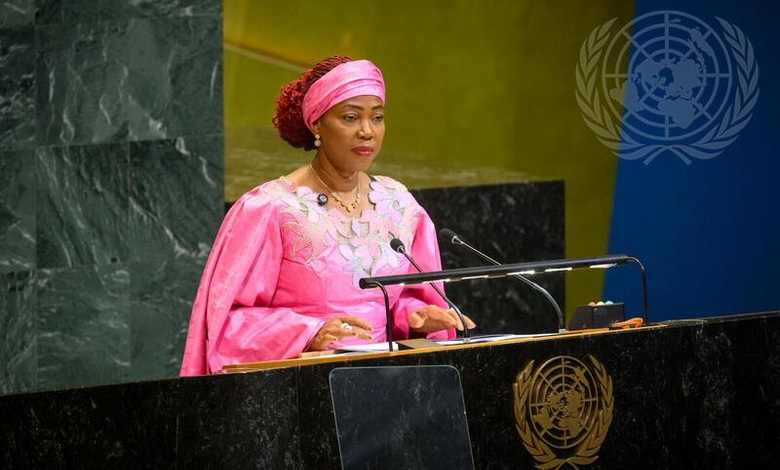
The General Assembly adopted draft resolution A/80/L.99 by consensus, establishing the International Day for the Elimination of Child, Early and Forced Marriage. Sierra Leone’s First Lady, Fatima Maada Bio, introduced the resolution during the plenary meeting. Nigeria was among the countries that co-sponsored the resolution. The first observance will take place on November 27, 2026.


Sierra Leone’s First Lady, Fatima Maada Bio, who introduced the resolution at the General Assembly, said the new international day would provide an annual platform to renew political commitments, strengthen advocacy, raise awareness, promote accountability and push governments to act against child, early and forced marriage.
“Today, the world has spoken with one voice: child, early, and forced marriage has no place in our societies.”
She described the resolution as more than symbolic, calling it “a global mandate for action” and reaffirming leaders’ and advocates’ responsibility to ensure every girl is free to dream, learn, and thrive without being forced into marriage.
The initiative comes as the global number of women and girls affected by child marriage remains enormous. UNICEF estimates that 640 million girls and women alive today were married in childhood, while around 12 million girls are married before the age of 18 every year. Globally, about one in five young women were married before 18.
UNICEF defines child marriage as a formal marriage or informal union in which at least one person is under 18. Girls bear the overwhelming burden and face consequences because marriage can coincide with the end of their education, early pregnancy, economic dependence and exposure to intimate partner violence. This new observance also comes as the world approaches the 2030 deadline for Sustainable Development Goal 5.3, which calls for the elimination of child, early and forced marriage and other harmful practices. UNICEF has warned that progress is too slow to meet that target at the current rate.
Africa faces a particularly heavy burden. In Nigeria, 33 per cent of women aged 20–24 were married or in union before turning 18, according to current UNICEF data. A 2025 UNICEF analysis found that more than 3.7 million Nigerian women aged 20–24 had been married before 18, with the prevalence approaching 50 per cent in the North-East and North-West. Poverty, geography, and access to education also shape the practice.
UNICEF’s Nigeria Situation Analysis found that child marriage was considerably more common among girls from the poorest households, girls living in rural areas and girls with little or no education. In its analysis using 2021 MICS data, prevalence among women aged 20–49 was 45.5 per cent in rural areas compared with 19.8 per cent in urban areas.
Keeping girls in school is one of the interventions with the strongest evidence. UNICEF found in 2025 that if every girl in northern Nigeria completed secondary school, child marriage could fall by as much as two-thirds, while adolescent pregnancy would also decline and economic productivity would increase. But education alone cannot resolve the problem; UNFPA has pointed to the need for enforceable laws, opportunities, healthcare, sex education, protection services and changes to the gender norms that make girls’ marriages acceptable to families and communities. It also stresses that girls who are already married must not be abandoned by programmes focused solely on prevention.
The choice of November 27 follows years of international work on the issue. The General Assembly had already adopted Resolution 79/158 on child, early and forced marriage, with Zambia and Canada playing leading roles in advancing that earlier resolution. Sierra Leone subsequently brought the proposal for a dedicated international day to the 80th session of the General Assembly.
Sierra Leone’s leadership is also tied to its own recent legal reforms. The country enacted its Prohibition of Child Marriage Act 2024, which prohibits marriage involving anyone under 18 and provides criminal penalties for those who marry, facilitate or encourage such unions.
On November 27, 2026, the UN will mark the first International Day for the Elimination of Child, Early and Forced Marriage. Millions of girls whose childhoods have already been cut short by marriage; however, the issue is not new, and neither is the demand for their right to remain children.