|
Getting your Trinity Audio player ready...
|
Summary: While the world celebrates women’s month, Nigeria does so through elaborate empowerment programmes. But the harsh reality of this empowerment shows itself in a surge of gender-based violence, femicide, and low conviction rates. Women’s empowerment in Nigeria is merely symbolic and serves as motivational language.
In the third month of every year, Nigeria joins the global celebration of women. March becomes witness to loud songs of women’s empowerment. Free skills, scholarships, conferences, and catchy social media hashtags are used to applaud Nigerian women for their strength, resilience, and leadership. Yet, beneath this rhetoric celebration lies a harsher reality, one where gender-based violence persists, women remain underrepresented in the political system, and justice proves difficult to access. But the question is: What does empowerment mean when women’s protection is not guaranteed? Why are women celebrated if access to real political power is limited and built on a patriarchal structure? What does support mean without justice?
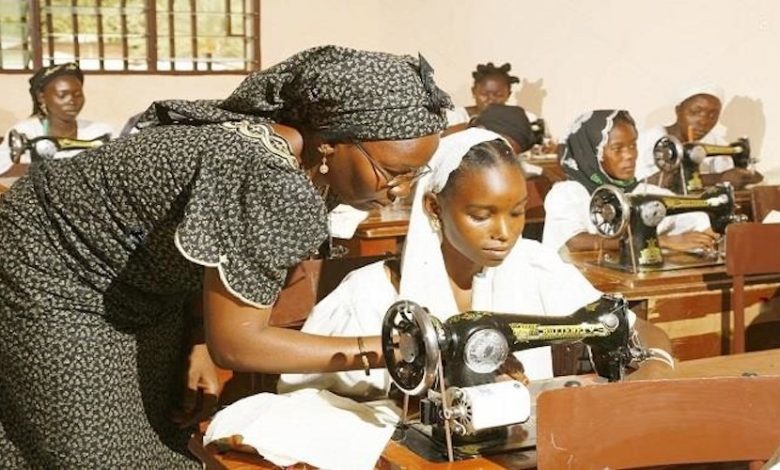
While Nigeria’s understanding of women’s empowerment translates into 5-week free skills-acquisition training, N50,000 for 5 female farmers, and a symbolic female leader at the state or national level, protection, access, power, and opportunities are taken away from them. This deeply contradicts the meaning and purpose of women’s empowerment. Nigeria’s women’s empowerment is simply a language of motivation for the highest bidder, aimed at making women dependent on others.
Describing Nigeria’s women’s empowerment as patronage and exploitation, especially during elections, Ms Kosichukwu Charity Ani, a gender equality advocate and contributing writer for Naija Feminists Media, greatly opposed this symbolic structure. She argued that empowerment should be a sustainable platform for helping people gain access and opportunities to be independent of others, so they can even empower others.


“Empowering women is not about charity or occasional gestures. It is about making changes in our everyday spaces, our workplaces, communities, and institutions, so that women can participate fully and safely,” she added.
From a legal standpoint, Dogo Joy Njeb, a practising lawyer and founder of SheResonance, defined empowerment as gender equality between men and women, meaning both genders are on an equal economic, political, legal, and social footing. She maintained that empowerment is a mental emancipation, and being financially empowered does not liberate women from patriarchal structures. Rather, empowerment starts with an equal mindset.
Meanwhile, Dooshima Eberechi Tobias, Benue State University law graduate and an aspirant for the Nigerian Law School, told NFM that women’s empowerment is the creation, interpretation, and enforcement of laws that protect women’s rights. She mentioned that, while laws exist, the low representation of women shows that empowerment remains limited. Thus, it’s more symbolic than real.
Among the phenomena of Nigeria’s symbolic women’s empowerment is the hypocritical celebration of women through demeaning words. Often, the so-called celebrations of women’s exceptional excellence are attributed to external factors rather than to their abilities. Therein, the organisers found ways to belittle women’s success through media framing, jokes, comments, and laughter. The worst part is the political realm, where women leaders are reduced to tools merely used during election periods because women make up a large percentage of voters.
Kosichukwu vividly described this issue as “patronage, not empowerment. It’s done for visibility and political gain, not long-term impact. The way empowerment is framed is insulting. Women are portrayed as helpless or as beneficiaries of charity, rather than as capable individuals,” she stated.
Empowerment Hypocrisy: Gender-based Violence Statistics
While Nigeria continues to celebrate women’s empowerment through public campaigns, motivational language and financial literacy training. Recurring cases of gender-based violence reveal a disturbing gap between rhetoric and the reality of many women and girls. One of such cases is the death of 13-year-old Ochanya Ogbanje, who died on October 17, 2018. Despite the massive public advocacy of the #JusticeForOchanya Movement# in 2018 and 2025, the rapists, her uncle and his son, never faced justice.
Ochanya’s story does not exist in isolation. In 2020, Barakat Bello, an 18-year-old student in Ibadan, was raped and murdered in her home. In the same year, Uwavera Omozuwa, a university student, was also brutally raped inside a church in Edo State, where she had gone to study. Like Ochanya’s case, both incidents sparked national outrage, with social media campaigns demanding justice. Yet the momentum that followed those protests gradually faded, leaving many questions about accountability unresolved. All the cases reflect a familiar pattern: public outrage, institutional silence, and then delayed justice.
Data from DOHS Cares Foundation further highlights the growing scale of this crisis. The Foundation’s dashboard reveals that 197 women and girls were killed in gender-related violence in 2025 alone. Yet, only 65 rapists were convicted between 1973 and 2019. If empowerment is meant to protect women, Nigeria’s gender-based violence statistics tell a different story. This persistent violence against women raises uncomfortable questions about the reality behind the language of women’s empowerment. True empowerment cannot exist where women’s safety and access to justice remain uncertain.
Speaking on the prevalent violence against women across the country, Joy explained to NFM that the Nigerian justice system failed women from the onset of reporting a case to the extortion fee, undertrained staff, and finally, delayed justice.
“Although a structure exists, there is poor implementation and utilisation. It seems justice exists more on paper than in actual reality,” she stated.
Dooshima shared that while the country’s legislative arm failed women externally, its internal errors cannot be dismissed. She calls it performative empowerment, where very few women lawyers rise to SAN due to a lack of mentorships and access to opportunities. Yet, bias and structural inequality still exist within the profession.
“If women are not well represented in decision-making spaces, the system cannot fully reflect their realities,” she opined.
The low conviction rates of crimes against Nigerian women do not only stem from delayed justice, but it is also from institutional inaction. The justice system does not merely need more laws; it needs to make the existing ones work. Law expert Joy describes this gap as an enforcement issue. According to her, “Nigeria has good laws that protect women, but their implementation is very low. It is in the area of inadequate laws that protect women and a lack of proper implementation that the law has failed the Nigerian woman, making the country the worst place for women to live in Africa.”
Beyond enforcement and adjudication, Dooshima shared that structural contradictions within the law itself further undermine implementation. She points out that “Section 42 prohibits discrimination, yet other provisions still disadvantage women.” These inconsistencies create ambiguity in legal interpretation and weaken accountability. So when laws conflict, enforcement becomes selective, and perpetrators exploit these loopholes.
Insights from these law experts reveal a wide gap between the accustomed notion of Nigeria’s symbolic women’s empowerment and the real protection that is missing from the nation’s justice system, policies, and advocacy efforts. While governments and institutions may promote empowerment through campaigns or small-scale economic programs, they do little to address systemic failures.
Political Underrepresentation and Tokenism
Beyond personal safety, the limits of empowerment also reveal themselves in Nigeria’s political sphere, where women remain significantly underrepresented. As the giant of Africa, Nigeria is ironically among the lowest countries with the lowest women’s representation in parliament globally. Women political leaders account for 3.9% of the National Assembly, compared with 96% male senators. Even more saddening is the illusion of empowerment, in which women are conferred symbolic leadership roles to enable men to attain the same roles. A clear example is the woman leader often used as a deputy to any prominent position to increase votes.
While the songs of women’s underrepresentation in the National Assembly still linger in the air, the case of Senator Natasha Akpoti-Uduaghan showed how hostile Nigeria’s political system is to women. She is one of the four female voices among the 109 senators, yet she was unjustifiably suspended for 6 months over alleged misconduct and a violation of Senate Standing Rules. Her case reflects a broader urgent concern: stark underrepresentation of women in the legislature and the rhetorical passive power they possess. On the other hand, Hon. Mojisola Lasbat Meranda, the first female Speaker of Lagos State House of Assembly, was unjustifiably coerced into resigning to give way for a male speaker. When Nigeria celebrates women’s empowerment as a form of political power, it is simply advocating for more male leadership in a structured patriarchal society.
Their cases raise a critical question: how does the Nigerian legislature truly reflect a system in which women are barely accommodated at the decision-making table? Hence, the issue is not about the women leaders in the Senate; it’s about the roles they assume without authority, creating the illusion of empowerment.
Women need to form a uniform group
To curb the facade of women’s empowerment deeply rooted in the Nigerian political system, Kosichukwu advocates that women leaders become indispensable so they can ask for what they want, negotiate for positions and opportunities, build alliances, and strengthen their influence. Ultimately, they need to support one another to become a uniform group.
“Women don’t need grants, they need access to markets, sustainable empowerment, inclusive policies and programmes that consider women with disabilities, religious differences, care responsibilities, and socioeconomic realities. Ultimately, women should not be portrayed as helpless or pitiful, but as capable individuals,” she advised against the country’s rhetoric of women’s empowerment.
From the justice viewpoint, the Nigerian bar aspirant recommends equal representation of women in the judiciary, mentorship programs, and greater institutional commitment to gender justice.
“The government should establish local structures such as dedicated units in communities to monitor and respond to violations,” she said.
On the flip side, the SheResonance founder told NFM that consistent, inclusive enlightenment programmes on women’s rights are a good starter for real women’s empowerment.
“Establishing refuge centres and alternative homes for women who are yet to find their feet after escaping domestic abuse, legislating and implementing laws that address women’s rights issues and better the conditions of women in society,” she added.