Unsafe Havens: How Intruders Turned UDUS Female Hostels into Hunting Grounds

|
Getting your Trinity Audio player ready...
|
A month-long spike in hostel break-ins across Gidan Yaro, Benji, Shama, and Gidan Nura, including a knife attack inside a school-owned hostel, is forcing UDUS female students to question whether any accommodation is safe.
Gidan Yaro: A Month of Break-Ins
A strange man lying in wait in the bathroom of a hostel exclusively for female students was not something Racheal had anticipated witnessing in her lifetime. The 400-level student of Usmanu Danfodiyo University, Sokoto (UDUS), and a resident of a private hostel in Gidan Yaro traced the genesis of the incident to an ordinary Saturday.
She had just returned from a crossover prayer around 1 am on August 1st, 2026, when Racheal realised there was light in her hostel. Being a not-so-usual occurrence, she decided to fetch some water outside before settling into the night, even though she noticed there was nobody else in sight.


A few minutes later, a strange man approached and offered to help her carry the water all the way to her hostel. Racheal says she politely declined his help because she wasn’t comfortable with it. The same person had been prowling behind her while pretending to be on a phone call.
A little while after the brief exchange, she could no longer hear footsteps from behind. He had closed the distance between them and almost immediately attempted to grab her.
“His hand was so close to my breast that it left me disoriented for a long time. I immediately dropped my buckets and sprinted into the hostel,” Racheal told Naija Feminists Media (NFM).
The encounter did not end there; using the broken door, the same man crept into her compound.
“He began banging on it, demanding I come outside. He said he wanted to touch my breast,” she recounted with disgust. “I told him he was disgusting and shouted for help. People in the compound heard me and called the landlord.”
The incident prompted the landlord to fix the broken door, but it did not stop the intruder from jumping over the fence to get in two days later.
Rachael’s ordeal is not an isolated one; the National Agency for the Prohibition of Trafficking in Persons recorded 756 cases of sexual and gender-based violence between January and July 2026 alone.
At UDUS, that danger has recently moved closer to the spaces meant to be safest. Naija Feminists Media interviewed more than ten residents across the affected hostels and confirmed intruders breaching six female hostels within the month of August alone, a spike that has left students questioning whether their accommodation offers any real protection at all.
The horrific memory of the first incident was yet to fade for Racheal when the same man returned three days later. She was sleeping, alongside many of her neighbours, in front of her room due to the heat when someone started throwing stones at them at 3 am.
“I initially assumed it was the local boys messing around, but it was very late for that, so I dismissed the thought and proceeded to relieve myself in the bathroom,” she narrated.
While approaching the bathroom door, a strange figure appeared from inside and reached out his hand to pull her in while attempting to cover her mouth. Racheal swiftly pulled herself away and let out a loud scream that alerted the sleeping neighbour.
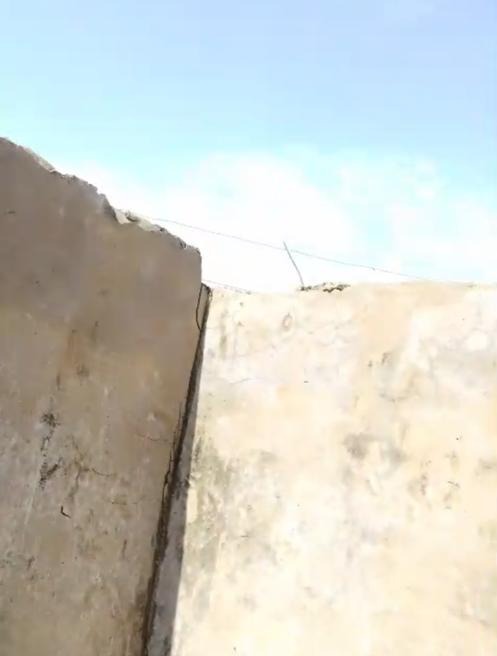
“He escaped through the fence because our toilet has no roof,” she added while noting that the most probable conclusion is that he entered the compound through the bathroom, since the main door was locked and there was no other way in.
While recounting the emotional toll the two consecutive incidents have put her through, Racheal says that she has not been able to eat properly ever since.
Benji: A Stranger Among Sleeping Students
Gidan Yaro was not the only hostel breached that month. In Benji, another private accommodation housing hundreds of UDUS students, an intruder didn’t just lurk or attempt contact; he actually got in, moved through multiple rooms undetected, and touched several sleeping students before fleeing.
Amina, a 300-level student, said she was asleep in the early hours of August 23rd when she saw a man in a white jalamia standing over and caressing her thighs. Shocked and scared, she dismissed her experience as an illusion.
“I thought I was dreaming until I woke my roommate to ask her if she was the one who rolled up the curtain, and she denied it,” she told NFM.
All of the affected rooms had their doors and windows opened due to the heat; despite phones and other valuables lying around, he stole nothing.
Another survivor of the same incident, Zainab, said she woke up to her roommate screaming and saw the man touching her sexually. By the time she struggled free of her mosquito net to help, he had already fled the room.
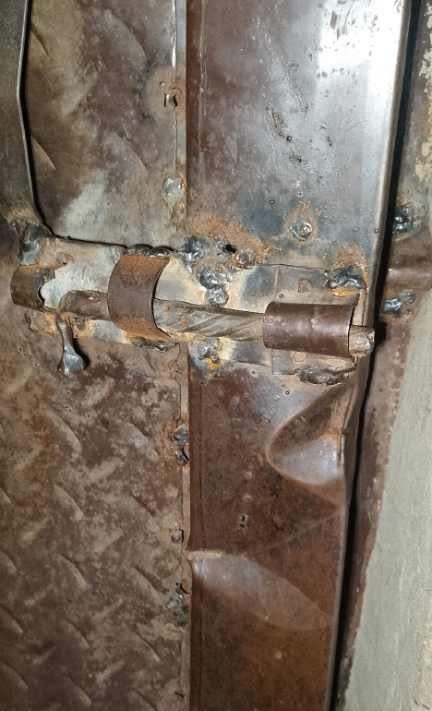
Residents attribute the incident to the lack of security at the hostel, which they believe gave the intruder room to act undetected. They said the compound’s entrance door has been unusable for weeks; although the landlord supplied a replacement weeks earlier, it was not installed.
Following inquiries, the landlord, Mallam Meigida, expressed distress over the incident and promised to fix the door as soon as possible. Two days later, a new door was fixed.
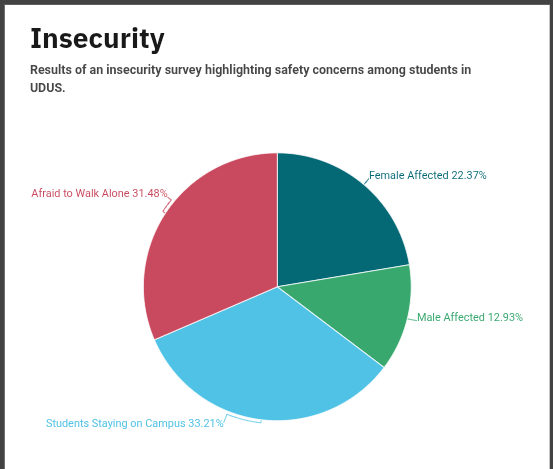
Insecurity is not a new phenomenon on UDUS campus, and data shows that it disproportionately affects female students. A 2025 Pen Press investigation into how safe UDUS students feel on campus found that 62.1% of female students reported experiencing safety concerns, compared to 35.9% of male students. Of the respondents, 92.2% live in school and privately owned accommodation located within the school, suggesting that the place many consider safer is where students feel most exposed.
Gidan Nura: Torchlight Through the Window
Daniella, a 400-level student and resident of another affected private accommodation in Gidan Nura, said the prevalence of intrusion has been sickening.
“We’ve been locking our doors, but the man still shines a torch and touches us through the window,” she said. The harassment, she disclosed, has persisted for two weeks, forcing residents to lock both doors and windows despite the heat.
Their landlord repaired the entrance door, but the window remains the point of entry.
“If we cover ourselves, he throws things through the window to provoke a reaction,” Daniella said.
He typically comes around 4 am. On one occasion, all the residents rushed out shouting “thief,” and he fled into a nearby maize field, only to return at 2 am the following night. Since then, residents have taken to locking their main entrance by 10 pm.
“We still hear footsteps sometimes, but since our doors are locked, no one has seen him directly since then,” she told NFM, adding that they’ve stopped reacting to sounds of footsteps.
The problem of insecurity in privately owned student accommodation is not new to university authorities. During a meeting with campus journalists in the 2025 academic session, the then Chief Security Officer, Colonel Abdullahi Gwandu, attributed the lack of security in these hostels to uncooperative landlords.
“I’ve given them many suggestions on how we can recruit security men who would take turns and man each hostel, but they didn’t want to implement it,” he said.
Security analysts have pointed to structural gaps, not just individual landlord negligence, as the root of the problem. Salihu Dantata Mahmud, Director of Security at Salute Nigeria Initiative, has argued that protecting schools amid Nigeria’s current insecurity ultimately falls on government agencies, the police, the Nigeria Security and Civil Defence Corps, and the Department of State Services and has called for consistent surveillance and a functioning communication system between schools and security operatives to track unusual movement around hostels.
He also stressed that schools should maintain direct interfaces with security agencies, while noting that responsibility does not rest solely with the agencies, since safety remains everybody’s business.
Down Valley: Knifepoint Inside a School-Owned Hostel
According to a recent NAPTIP-backed report, one in every five Nigerian women aged 15 to 49 has experienced physical or sexual violence, a national pattern UDUS is not spared from. But the security threat is not confined to private hostels that the school bear little responsibility for alone. Down Valley, a female hostel owned and managed by the school, became the target of a knife-wielding intruder on August 26, 2026, three days after the Benji incident.
Rukayat, a 500-level student and resident of Block Q, had gone outside around 5 am to relieve herself when she noticed a figure walk past and slip into her block’s corridor. Moments later, the same figure reappeared, peering at another student who had stepped out to perform ablution for the Fajr prayer.
“Initially, I had not noticed that the person was a man because he had some form of covering over his body,” she told NFM. She kept watching in the dark as he retreated behind a date tree, then moved back toward the toilets, apparently surveying the area before turning in her direction.
Still uncertain what she was seeing, Rukayat stayed still, hoping he would leave the way he came. Instead, he began walking toward her. It was only when he was dangerously close that she flashed her light at him and saw him discard the covering, knife in hand, and lunge toward her.
“I panicked and ran, shouting with everything inside me for help,” she said. Her scream woke the entire block. She ran to her room, where her roommate was already trying to lock the door, and begged to be let in.
Security personnel arrived afterwards and recovered the knife the intruder had intended to use, though they did not come directly to Rukayat’s room. She was asked to return for questioning later that morning, still shaken.
“This is not the first case of men entering the female hostel. It is not even the second time,” Rukayat said. Her parents, she said, had specifically chosen the school hostel over private accommodation because they believed it was safer.
“Imagine the irony of the situation,” she said. “I was simply where I was supposed to be. I was attacked inside the place that was supposed to be my safe space.”
Days later, Rukayat says she still struggles to feel secure in her own room. “I do not seem to understand the weight of worth that the school places on the lives of its students,” she said. “We deserve to feel safe where we live, study and worship.”
Rukayat’s ordeal, like the others before hers, was an intrusion: a strange man entering a space men are clearly forbidden to enter. But the data suggests that the common threat to female students may not be a stranger at all.
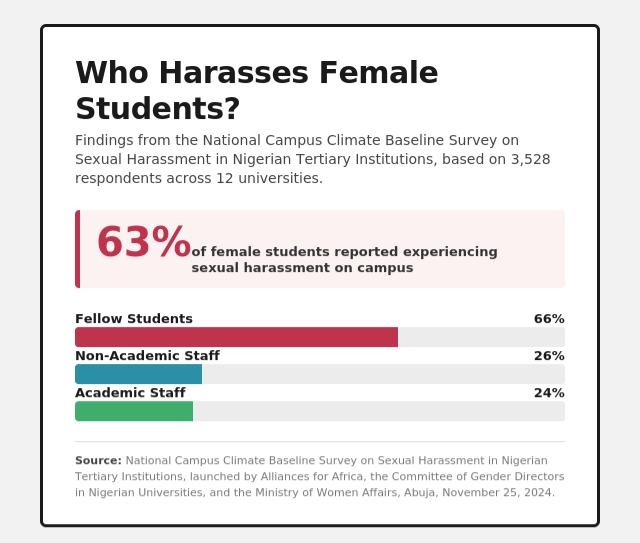
A National Campus Climate Baseline Survey on Sexual Harassment in Nigerian Tertiary Institutions, conducted across 12 universities, found that 66% of female students who reported experiencing harassment identified fellow students, not intruders, as the perpetrators. Sixty-three per cent of female students surveyed said they had experienced sexual harassment on campus overall.
The Dean of Students Affairs, Professor Zayyanu Umar, when confronted with the investigation, said the university has devised strategies to prevent such incidents from recurring.
Other analysts have pushed for a more localised fix. Hassan Soweto of the Education Rights Campaign has called for an intelligence-driven security committee made up of elected student representatives who can liaise regularly with campus security and the police to share information and flag invasive activity early. That kind of structure, if adapted for UDUS’s private and school-owned hostels, would close the gap perpetrators currently exploit.
Until proper coordination is in place, the burden of vigilance will continue to fall on female students, even if it means locking windows despite the heat.
Editor’s Note: Names of the students have been changed to avoid victimisation