|
Getting your Trinity Audio player ready...
|
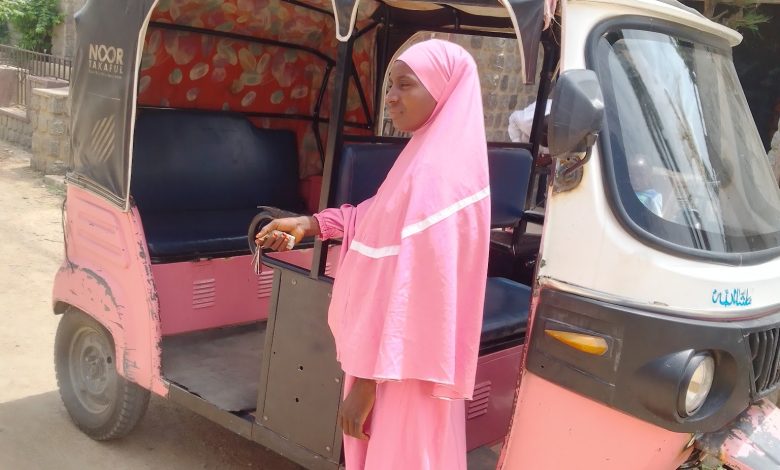
When Salma Salisu, a mother of eight, first heard about a programme recruiting women to drive commercial tricycles in Kano, she hesitated. The job had long been seen as men’s work. When she told her family she wanted to join, her husband supported the decision, but her children were sceptical.
“They didn’t want me doing men’s work,” she said.
But as her eldest daughter prepared to enter higher education, Salma knew her income from petty trading could no longer cover the additional costs of tuition and books. She decided to take the wheel.
“It was painful to watch as I was not able to provide. I was scared, but my will outweighed the fear,” she said.


Salma Salisu lives in Dorayi, Gwale Local Government Area of Kano State, and is a mother of eight. Before she joined commercial tricycle driving, she sold plastic utensils. However, her business had been marred by the problem of extending credit to close family and friends.
“You would send your children to collect the money, and they would even be insulted,” Salma said.
The unpaid debts affected her ability to restock her goods, slowing down her business and reducing her profits. Her effort to earn a better income for her family eventually led her to join the women-only transport initiative, Matazalla.
The new job brought a change in her income.
After paying ₦3,000 for the day’s battery charging and making her daily repayment, Salisu says she is still able to support her children and her family with the income.
“After deducting everything, I made an income of ₦5,000 to ₦10,000. It all depends on the day’s work. Some days there are many customers; other days are dry,” said Salisu.
Salma’s experience reflects a much broader pattern.
According to the World Bank, commercial transportation is dominated by men, with women making up only 5 per cent of workers operating commercial vehicles.
Simbiat Bakare, a women’s rights activist, says women’s entry into the transportation sector is compounded by financial bottlenecks, gender bias, and sexism.
“Getting a bus or tricycle is expensive in Nigeria, and women may not get support from their families because it is viewed as a traditionally male field,” she said.
Simbiat added that recruitment into the industry often favours men, locking women out of breaking into the profession.
The programme that would attempt a solution began with a concern for women’s safety.
In 2023, a grassroots community initiative, Matazalla (meaning “women only”), wanted to create a safe space for women that reflected the religious and cultural values of the state.
According to Hauwa Ahmad, president of Matazalla, the organisation was prompted to look for an alternative after women complained of harassment while using commercial tricycles.
The organisation first tested its hypothesis about cases of harassment by consulting the Hisbah Board, the agency that handles moral and social regulation within Muslim communities in Kano, where it learnt that women passengers had lodged previous complaints.
To realise its objectives, Matazalla partnered with Alternative Bank to introduce a tricycle through a lease-purchase model. The bank provides electric tricycles, which riders repay through daily instalments over three years. According to Hauwa, most riders have repaid between 50 and 60 per cent of the total lease cost of their tricycles.
Financial lifeline for many
Commercial tricycle driving has become a financial safety net for women like Salisu.
Sakinat Isah is another rider who came across the programme by chance. That afternoon, she recalls, she was returning home from the market and had already stopped a keke when she sighted the pink tricycle driven by a woman.
“It was my first time seeing a woman on wheels. I apologised to the other keke driver and entered the pink one. I was impressed.”
They soon got talking, and Sakinat expressed her interest.
“I said, ‘If I see this type of work, I would do it.’ I joked.”
Months into the programme, Sakinat says it is the first job that has enabled her to sustain herself.
“The way I looked before this work is not the way I look now,” she said.
Like Salisu, Sakinat says the job has given her a reliable source of income and the ability to support herself.
For others like Aisha and Hussaini, the motivation is simply their passion for the job.
“To be honest, I just like the job. That’s why I joined.”
Barriers that Still Remain
Beyond the success stories, multiple interviews with riders point to scenes of intimidation, harassment, and bullying from their male counterparts on the road. The women refer to them as Yan Yellow, a reference to the yellow tricycles the men operate.
For Salisu, the experience was harrowing and a constant source of dread as she went about her work.
“There’s this day I just cut a corner when a Dan Yellow barked at me and spat at me. I will never forget that day. I have been called a prostitute more times than I can remember,” said Salisu.
While there is praise and admiration from some members of the community and their families, there is also rejection and the social stigma attached to the job.
“I just want to do my job and take care of my children. I don’t know why that should be a problem,” she added.
For women to thrive in the transportation business, Simbiat says the government must design structural systems and policies, from the national to the local level, that ensure inclusive recruitment and fair treatment of women.
“Harassment should be promptly addressed and penalised. We already see women entering the sector; we just need to increase their participation and make sure it is sustainable for them,” she said.
The president of Matazalla acknowledged the incidents. She said one rider became so frightened during one of these confrontations that her tricycle tumbled on the road.
To address the problem, the organisation met with the Kano State Keke Riders Association and explained that the women were not competitors but were there to protect their dignity through meaningful employment. Matazalla also appealed to the association to encourage its members to see the women as fellow workers rather than competitors. Matazalla has since registered with the association to demonstrate its commitment to building meaningful collaboration.
However, some riders say the intimidation still continues despite the meetings.
Beyond these challenges, the organisation’s lack of electricity means batteries cannot always be charged. According to the riders, they are often unable to take two fully charged batteries because one has to remain plugged in for charging. As a result, they make do with a single battery, which they say is often not enough to last the entire day or earn enough income to meet their daily repayment and household needs.
Despite these challenges, the prospect of eventually owning their own vehicles gives the women hope.
“The day I receive the final papers of ownership, I will hold a big party,” said Salisu.