How Malnutrition, Child Labour Threaten Sokoto Girls’ Future
|
Getting your Trinity Audio player ready...
|
There was no sign of childhood innocence or curiosity on Umaimah’s face when she was first seen skimming through the smelly waste bag left outside a student hostel at Usmanu Danfodiyo University Sokoto (UDUS), in search of something edible.
Her face lit up in delight when she found an almost empty bottle of Fanta, and with no visible expression of concern about its edibility, Umaimah gulped down the contents at once.
When approached by Naija Feminists Media (NFM), she disclosed that searching for food in a waste bag is just a secondary means of survival when work is slow. The 10-year-old performs menial tasks for UDUS students, which, according to her, include sweeping, mopping, and fetching water.
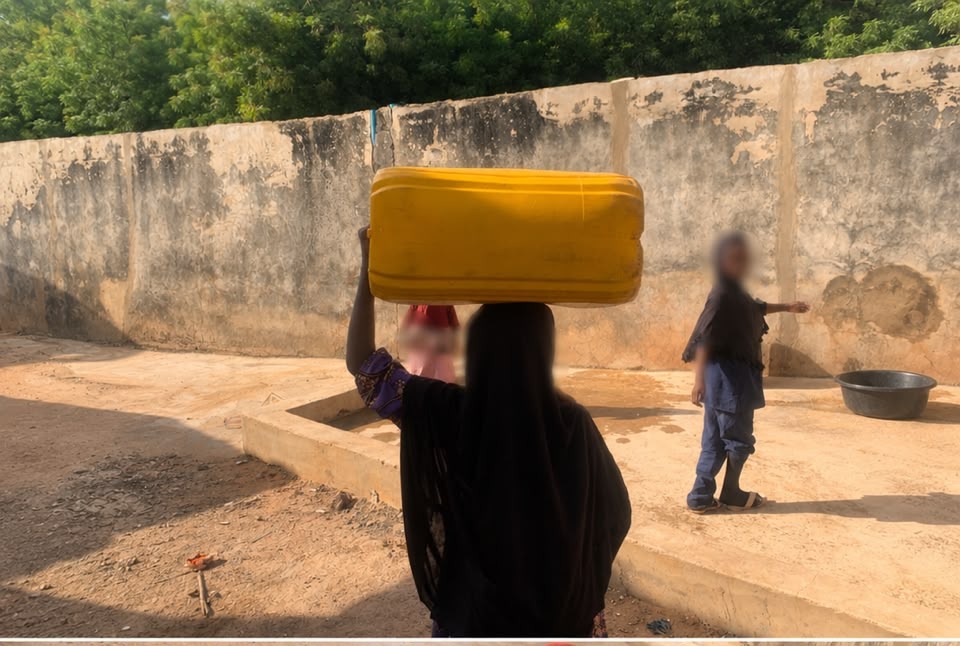
Umaimah carrying 25 litres of water. Photo credit: Maryam Umar/Naija Feminists Media


Umaimah has worked for so long that she cannot say exactly when she started. Born in the nearby village of Gidan Yaro, she grew up working as a labourer.
And like many other girls whose futures have been predetermined by their parents’ circumstances, she has no dream to achieve or fail at; the only thing Umaimah looks forward to is marriage.
“It has become a culture here that once you start growing up, you are expected to take care of yourself, so I only dream of getting married,” she told NFM.
What determines growth in this context is not biological or legal; it is measured by the ability to contribute economically.
Umaimah’s mother, Mallama Aishat, who is primarily a full housewife but occasionally washes people’s clothes, disclosed that she has three children working for students on campus, and seven in total. She discloses that it’s hard to fund the upbringing of many children from the meagre income her husband earns from working as a security guard in one of the school hostels.
When asked why her children work instead of attending school at such an early age, she points to the miscellaneous costs that come with schooling even where government tuition is free, costs the family cannot absorb. Still, she says, her biggest dream is to see her children in school.
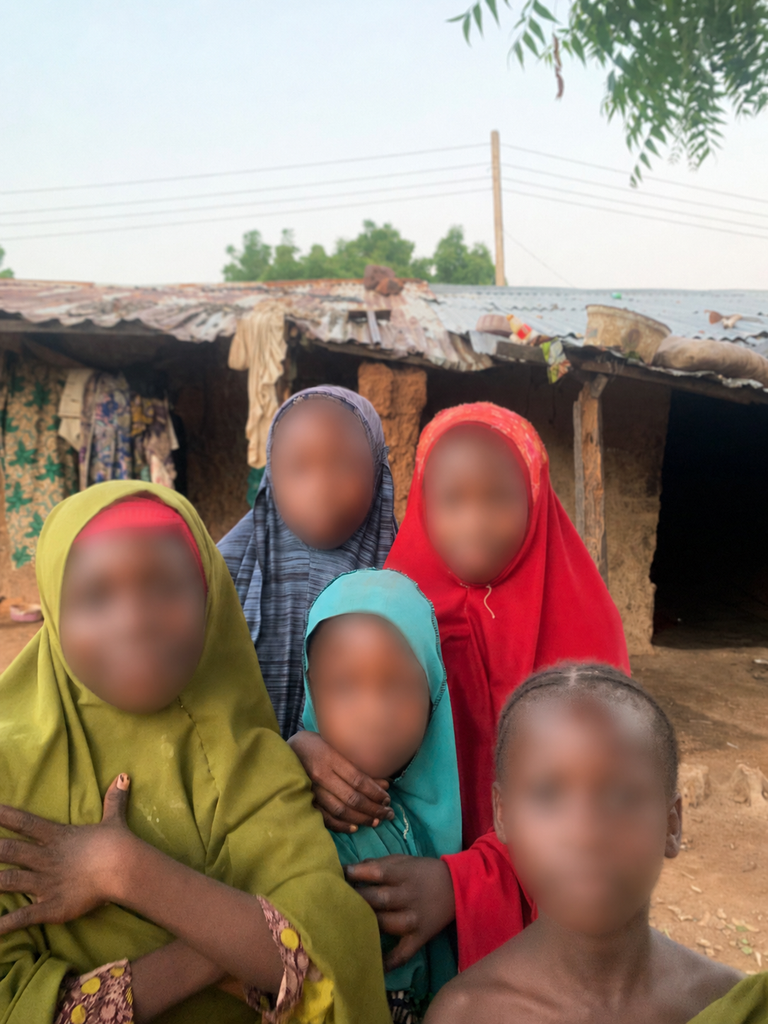
Umaimah and other working girls during visit to her mother
The Sokoto State Government is one of the few states in Nigeria that offers free education from primary through university, but Umaimah has never dreamed of taking advantage of the opportunity. If she enrolled, no one would feed her or cover her miscellaneous expenses.
Between The Law and the Lived Reality
Under Nigerian law, education for children is not a privilege left to culture or circumstance. Section 15 of the Child’s Rights Act 2003 mandates free, compulsory and universal basic education for every Nigerian child, while Section 28 explicitly prohibits exploitative child labour, barring children from work that is likely to be hazardous, that interferes with their education, or that is injurious to their health or physical, mental, spiritual, moral or social development.
Section 28(3) further makes this an offence punishable by a fine of up to ₦50,000, five years’ imprisonment, or both. This means, legally, Umaimah’s daily routine of sweeping, mopping and fetching water in place of school falls squarely within what the law was written to prevent.
Deborah Ekone, a legal practitioner, told NFM that the bigger problem is not the absence of law but the gap between what the law says and what happens in reality. She noted that a large share of child labour in Nigeria happens in the informal sector, in homes, markets, farms, on the streets, in domestic work and, as this report shows, on university campuses, spaces with very little regulatory oversight. Even where laws exist, identifying the children being exploited and holding the responsible parties accountable is difficult, compounded by inadequate resources for enforcement agencies, limited labour inspections, weak reporting mechanisms and poor coordination between institutions.
That gap, Deborah argues, has a gendered shape. Girls are often pushed into forms of labour that are less visible because these tasks are culturally framed as what girls are simply supposed to do; they are rarely recognised as exploitation.
“A girl fetching water and washing plates for university students all day is described as ‘helping out’ or earning her keep, when in reality she is missing school, going hungry, and being denied a normal childhood experience,” Deborah says.
Despite consistent labour, which sometimes affects Umaimah’s physiological health, she has never visited a hospital. When sickness comes, she buys drugs herself and continues.
“If my condition becomes too serious and I cannot continue, I stop working because I have no alternative. But this means I have nothing to eat, so I always force myself to work,” Umaimah discloses flatly.
Hunger as a Usual Routine
Like many other kids in Nigeria, Umaimah’s parents cannot afford the prescribed nutritional requirements. Her normal eating pattern is once a day, but on a good day she eats twice. Semi-spoiled or totally unhealthy snacks found while doing dishes serve as supplementary meals.
“I occasionally find snacks around the school when I’m lucky,” she says.
Adenike Adedokun, a Nigerian Nutritionist who reviewed the girls’ feeding patterns for this report, says the short-term effects of eating spoiled foods—food poisoning and dehydration— are not the most dangerous consequence. If continuous and left untreated, it could lead to Organ and Systemic Damage because certain dangerous strains of bacteria like E. coli produce toxins that can damage blood vessels, leading to conditions like Hemolytic Uremic Syndrome (HUS), which causes sudden kidney failure
Nafisat, another young girl working on UDUS campus, unlike Umaimah, does not know her exact age. She thinks she is between 12 and 13 years old.
She works four to six hours daily, washing plates, scrubbing clothes, and fetching water. Nafisat reports that she earns roughly ₦5,000 per week, yet she rarely spends her earnings on food. “I save my earnings for study expenses,” she says.
Nafisat primarily relies on leftovers from her employers, the students who sometimes pay for her services with food.
“I can tell that the food given to me has gone bad,” she says, without defiance or shame. “But because of hunger, I still eat it.”
Prisca Iwendi, a women’s rights advocate, argues that hunger patterned this way is not simply about scarce food but about who eats first. In many households, she says, fathers and sons are served first or given larger portions because they are seen as doing the “real work,” while girls eat last or eat whatever is left.
“Scarcity is a condition. Distribution is a choice,” Prisca says. A girl already doing physically demanding labour but consistently underfed, she adds, is left in a cycle of malnutrition and vulnerability that has little to do with how much food a household actually has.
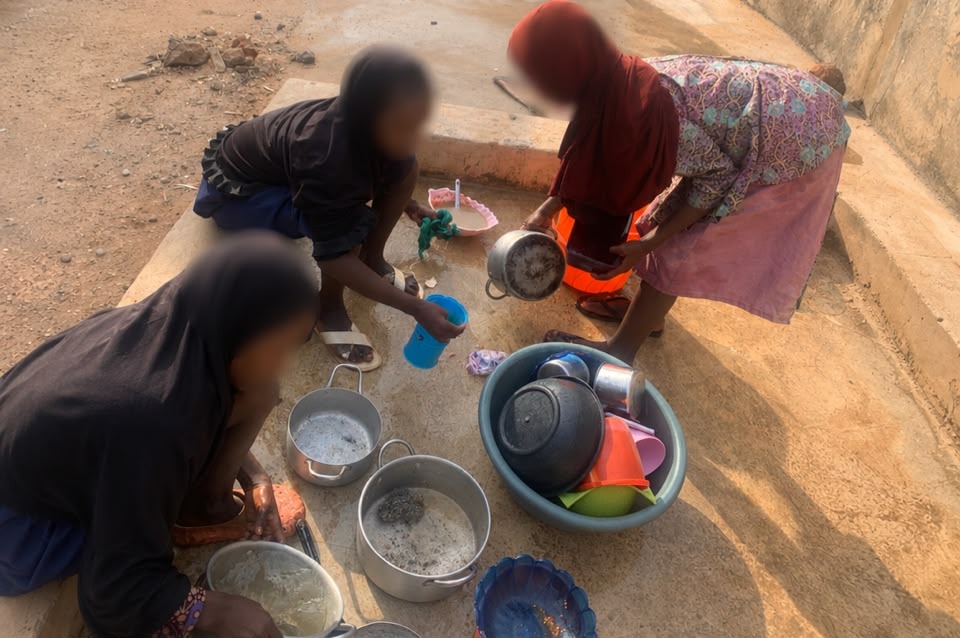
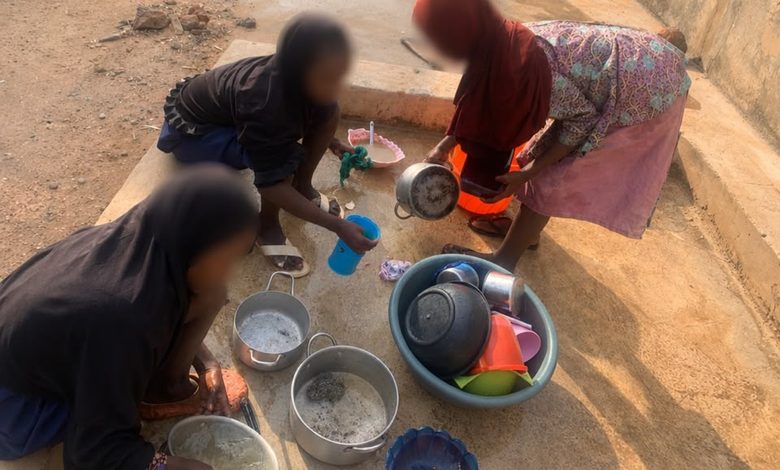
Working girls washing dishes outside a UDUS hostel. Photo credit: Maryam Umar
Girls at Risk of Death due to Systemic Failure
Médecins Sans Frontières (MSF), an organisation that has operated in Nigeria since 1996, treated more than 440,000 children for malnutrition in 2025, the highest number the organisation has recorded in the country in recent years.
Many children admitted for malnutrition, MSF’s Medical Coordinator Bukola Oluyide explained, were also battling illnesses such as measles and malaria, which weaken the body and reduce the ability to absorb nutrients.
This positions malnutrition as both a cause and a consequence of other diseases, including stunting. Adenike further notes that a child surviving on one meal a day, supplemented by spoiled snacks and leftovers, is not simply hungry but is in a state of chronic nutrient deficit that the body starts to normalise.
“Once hunger becomes routine, children stop reacting to warning signs like spoiled food or fatigue,” Adenike told NFM. “The body prioritises calories over safety.”
But Nafisat’s body no longer feels the iron being depleted from her blood; instead, she feels hunger overriding her ability to recognise spoiled food.
Adenike adds that chronic malnutrition in children occurs when there’s a long-term deficiency, excess, or imbalance in nutrient and energy intake. It includes undernutrition, overnutrition, and micronutrient deficiency.
Beyond small stature, it affects physical growth and brain development.
“It can lead to stunting, body weakness, and impaired immune function, among others, which can put a child at risk of death.
According to UNICEF, an estimated 2 million children in Nigeria suffer from severe acute malnutrition, but only two out of every 10 children affected are currently reached with treatment.
For girls specifically, the costs of malnutrition coupled with child labour are gendered and generational.
Adenike explains that prolonged undernutrition in girlhood carries long-term skeletal and metabolic risks. A deficiency in calcium, vitamin D, and energy intake prevents proper bone mineralisation, raising the risk of early-onset osteoporosis and fractures later in life. Malnutrition, especially when followed by a rapid shift in diet, also alters insulin sensitivity, increasing susceptibility to metabolic syndrome and Type 2 diabetes.
Hassan Habibah, a 500-level Law student at UDUS, expressed dissatisfaction over the girls’ situation. She says her first encounter with children as young as three years old working so hard was in Sokoto.
“I always feel bad when I see them loitering around during school hours, but there’s nothing I can do about it,” she told NFM.
Habibah noted that engaging their services means contributing to child labour, and not engaging equals leaving them to starve.
“I don’t even think there’s an innocent option; some of those girls speak English just from interacting with students. They deserve to be in school,” she added.
The matron of Fatimah Ibrahim Balarabe (FBI) female hostel and the girls’ direct point of authority on campus says most of them come from nearby villages to earn money, and that their movement has been restricted within the school, though students still go out to call them for work.
She attributes the girls’ occasional theft from students to this arrangement, and says disputes between them and students are hers to settle, with punishment handed down when necessary.
Saving for School, Surviving on Leftovers
Unlike Umaimah, Nafisat attends both conventional and Islamic school, a rare dual enrollment that should promise a difference. But the classroom is merely a temporary escape. “Immediately after returning from school, I go straight to work so that I can get something to eat,” she says.
Despite juggling labour with her academic workload, Nafisat dreams of becoming rich enough to take care of her family.
Safiyah Abdullah, another of the many working girls on the UDUS campus, states her age with certainty: 10. Unlike Umaimah and Nafisat, Safiyah works only in the morning.
“I work only in the morning and usually finish by 1:00 p.m. My father does not allow me to work in the evening,” she says.
Despite having a father who should bear her financial responsibility, Safiyah only attend the community Islamic school, and when asked what she wants to become, she offers the same foreshortened answer:
“I only wish to get married when I grow up.”
When “Growing Up” Means Marriage, Not a Future
Data show that 33.5% of the female population in Sokoto State have been married before 15, with some 12.8% having had at least one pregnancy before that age.
This data reflects that child marriage has become a culture and the long-term economic freedom of the children is rarely considered.
Deborah notes that girls who experience poverty, exploitation and educational exclusion become more vulnerable to early marriage, early pregnancy and sexual exploitation, outcomes that then affect their physical and mental wellbeing and their ability to make decisions about their own bodies.
Prisca also adds that when a girl grows up being told, directly or indirectly, that her role is to serve others, sacrifice and endure hardship, she can begin to internalise that message. She may start believing her needs are less important than those of her brothers or other family members, which shapes her perception of her own worth.
Aware, yet complicit
These girls are not the first working girls UDUS has had to reckon with, and the university is aware of their existence. In May 2024, the Office of the Vice Chancellor’s Student Affairs Division issued a notice to all students residing in the hostels, directing that girls referred to internally as “Yarinya Girls” be barred from entering any female hostel, citing “numerous sanitation challenges.”
Matrons were instructed instead to designate stations outside each hostel where the girls would gather to receive errands from students. The notice warned that any student found in violation would be ejected from the hostel.
The directive, signed by the then Deputy Dean of Student Affairs, treats the presence of these girls as a hygiene problem to be managed rather than a child labour and welfare issue requiring intervention.
It formalises their access, funnelling them to fixed collection points, without addressing why children as young as five are earning their food and school fees through hostel labour in the first place. Two years on, girls like Nafisat and Safiyah still wash dishes for leftovers, and still save wages toward marriage rather than tuition.
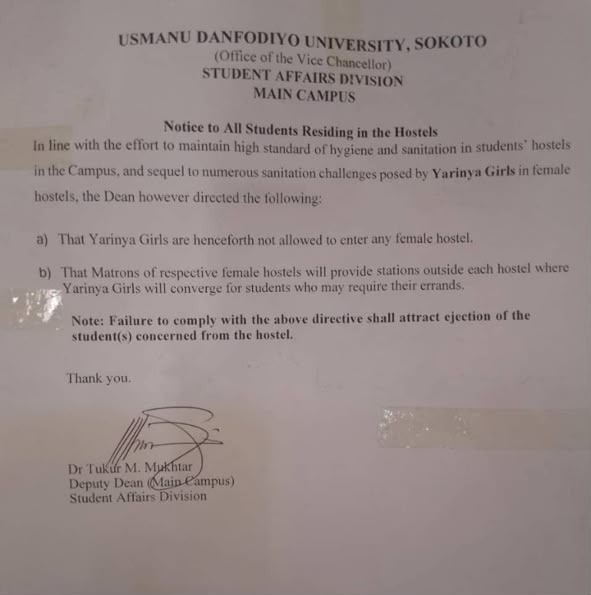
UDUS Student Affairs Division notice, May 2024, barring “Yarinya Girls” from female hostels. Source: Pen Press UDUS Facebook archive.
The Commissioner for Women and Children’s Affairs for Sokoto, Hajiya Hadiza Ahmed Shagari, did not respond to messages and calls when contacted. Naija Feminists Media eventually visited her office, and the receptionist said she wasn’t available.
Way Forward
Deborah emphasised that we must dismantle the conditions that produced the vulnerability in the first place: poverty, lack of access to education, healthcare and social protection. Removing a girl from exploitative work while sending her back to a household that cannot afford food or school fees does not end the cycle; it often just relocates it. Education, nutrition, and social protection must be treated as child-protection measures in their own right, not separate from them.
Prisca pushes the framing further, insisting this is a gender justice issue and not merely a poverty issue that happens to affect girls. Poverty, she argues, does not affect every child the same way; gender determines who is expected to perform certain kinds of labour, who sacrifices their education first, and whose needs are prioritised inside the household. Naming it as poverty alone, she says, keeps the response focused on household income without ever challenging the belief that a girl should sacrifice her schooling for the family.
She also emphasises that Nigeria’s regulatory framework makes provisions for girls’ rights. The African Children’s Charter prohibits discrimination and harmful practices, and domestically, the Child Rights Act, the VAPP Act, the National Gender Policy and the Constitution’s guarantee of dignity already cover what girls like Umaimah, Nafisat and Safiyah live through daily. What is missing, Prisca says, is enforcement, and the reasons for that gap are identifiable, which means they are fixable.
“We are asking this country to accept that a girl’s hunger, in a home where her brother is fed, is not a shortage,” Prisca says. “It is a verdict passed on her before she could speak, executed daily, and enforced by every institution that agreed not to look inside the house.”