|
Getting your Trinity Audio player ready...
|
Summary: On Thursday, April 16, 2026, a video circulated on X showing a JAMB candidate forced to remove her hijab before entering the premises of the Esther Oshikoya computer-based test (CBT) centre in Ibadan, Oyo state, for her examination. To determine whether JAMB prohibits hijabs during registration and examinations, Naija Feminists Media conducts an analysis.
On Thursday, April 16, 2026, a video circulated on X showing a JAMB candidate forced to remove her hijab before entering the premises of the Esther Oshikoya computer-based test (CBT) centre in Ibadan, Oyo state, for her examination. This video has sparked backlash and criticism among Nigerians, with many raising concerns about whether candidates’ religious rights are being consistently respected at CBT centres nationwide.
Safeguarding and advocating for women’s rights, freedom, and agency are among the firm tenets of feminism. Hence, Naija Feminists Media conducts an analysis to check if the National examination (JAMB) prohibits Muslim women from wearing their hijab for the examination.
Hijab and JAMB
A hijab is the outer clothing that Muslim women wear to cover their hair and heads. Its use is rooted in Islamic ideals of physical and spiritual modesty. Historical records and online trends indicate that incidents of hijab removal at JAMB centres recur almost every year.
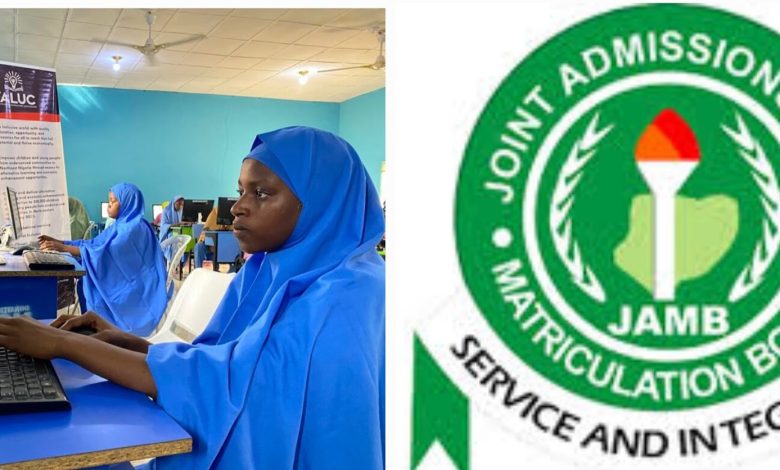
On April 25, 2025, Lawal Hameedat Adenike, a Muslim teenager, was forced to remove her hijab at the PEFTI CBT centre in Ibadan, Oyo state. Similarly, in 2023, female JAMB candidates wearing hijabs were reportedly delayed and denied entry for the mock UTME at Covenant University, Ota, Ogun State. While JAMB continuously intervened on behalf of every affected candidate, it often attributed this discrimination to overzealous staff, who, in turn, claimed the order came from above. But does Jamb truly prohibit female Muslims candidates from wearing hijabs for the examination?
JAMB Dress Code Policy
In a bulletin released on November 14, 2023, JAMB strictly stated its appropriate dress code, which includes simple, modest clothing, such as gowns, tops, and skirts or trousers that cover the body properly. It prohibits indecent dressings that are seductive and provocative, such as sleeveless tops, body hugs, knickers, transparent clothes, canopy headties, bogus fashion jewellery, spaghetti tops, and off-shoulders. Based on this stipulated policy, it can be concluded that the hijab is an accepted and appropriate dress code for the national examination because it meets the criteria for proper body coverage and is not seductive or provocative.
In addition, section 38 of the Nigerian Constitution of 1999 (as amended) guarantees freedom of religion and prohibits discrimination. It protects Muslims’ right to practise their religion, including thier appearance in line with their faith.
Usage of Hijab during JAMB photo capturing
In regard to the alleged discrimination against Muslim candidates at Afe Babalola University during photo capturing in February 2026, the Joint Admissions and Matriculation Board clarified that candidates are not required to remove their hijabs during registration. It stated that candidates’ ears must be visible for biometric verification, which is a standard technical procedure for identification similar to that used in passport or visa applications. This ear’s visibility requirement can be achieved by adjusting the hijab, not removing it. Moreover, the adjustment of the hijab for photo capture must be done respectfully. If a candidate refuses to comply with the ear-visibility guideline, they may be asked to formally state in writing that they chose not to comply, to prevent future misunderstandings, but the hijab itself does not need to be removed.
“For clarity, candidates are not required to remove their hijab. The simple requirement is that the ears be visible during photo capture, which can be achieved without removing the hijab. This is a standard biometric procedure, similar to what is obtained during passport or visa applications at embassies worldwide,” the board reiterated.
JAMB Reacts
In response to the recent hijab removal incident at Esther Oshikoya computer-based test (CBT) centre in Ibadan, an official statement made public on Thursday, April 17, 2026 and signed by Fabian Benjamin, JAMB spokesperson, stated that no candidate wearing hijab should be asked to remove or alter it.
The statement confirmed the board’s awareness of the incident and prompt intervention. The examination body condemned the action, adding that religious expression is a fundamental right protected under its policies and the 1999 Constitution of Nigeria.
“The board wishes to state clearly that this act was neither perpetrated by the centre nor part of its official protocol. Rather, it was the action of an overzealous ad hoc staff member who failed to adhere to the board’s established guidelines regarding candidates’ religious attire,” the statement said.
“We assure all candidates, regardless of faith, that their rights to religious expression, including dressing, remain a cornerstone of our policy,” JAMB said.
The board stressed that the incident did not reflect its official policy or approved procedures. It added that all ad hoc staff have now been reminded of the proper screening procedures to prevent similar incidents.
“For the avoidance of doubt, all ad hoc staff have been further briefed and reminded of the approved procedures for screening candidates at all centres,” the statement added.
Conclusion
Mandating female JAMB candidates to remove their hijabs during photo capture or examination is an unconstitutional order not stipulated in the board’s policies or guidelines. The examination body has continuously denied being part of such a policy.
It’s firmly maintained that all religious dress is respected. Moreover, the body adheres strictly to Section 38 of the Nigerian Constitution, which guarantees freedom of thought, conscience, and religion. Hence, prohibiting Jamb candidates from wearing hijabs during photo capturing or examination is not stated in the board’s established policies or guidelines.