NFM X Space: Stakeholders Examine Religion’s Impact on Women’s Rights, Gender Equality
|
Getting your Trinity Audio player ready...
|
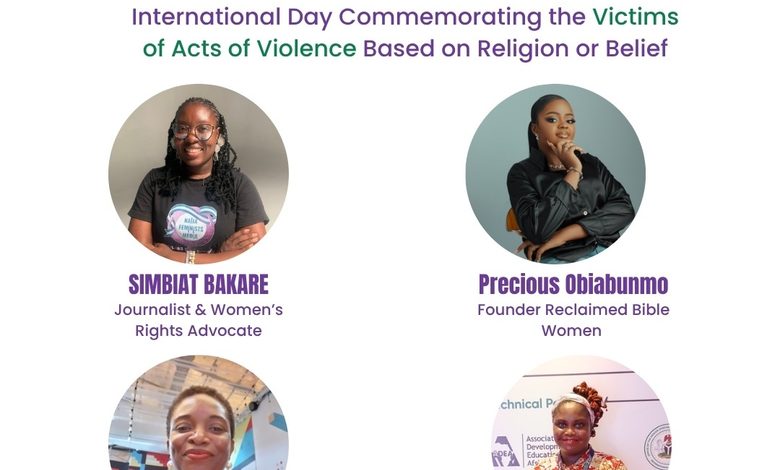
To commemorate the International Day Commemorating the Victims of Acts of Violence Based on Religion or Belief, Naija Feminists Media (NFM) hosted an X Space discussion on how religious beliefs, interpretations, and practices shape women’s rights and gender equality.
The session featured NFM founder and journalist Simbiat Bakare; founder of Reclaimed Bible Women, Precious Obiabunmo; lawyer and feminist researcher Jenifatu Yakubu; and training coach and mental health advocate Ebunoluwa Oyebade.
Moderated by Lucky Onyechere, the discussion examined how religious practices can reinforce gender inequality and how women can challenge harmful interpretations while respecting freedom of religion and belief.
Speaking on the need to question religion, Simbiat Bakare said examining religious beliefs and practices should not automatically be viewed as an attack on faith. She noted that religion is deeply integrated into people’s lives in Nigeria, influencing issues such as appearance, relationships and marriage.


“Questioning religion, having conversations about religion and how it affects women’s rights is not necessarily an attack,” she said. “If we are to be serious about gender equality, if we are to be serious about women’s rights, then we cannot shy away from these conversations.”
Simbiat added that she could not advocate for women’s rights while refusing to critically examine a belief system that also shapes women’s lives. On patriarchal interpretations of the Bible, Precious Obiabunmo, Founder of Reclaimed Bible Women, said some passages, particularly teachings attributed to Paul, have been used to limit women’s rights and agency.
She cited interpretations that encourage women to remain silent in church, prevent them from teaching or exclude them from leadership, noting that such passages are sometimes taken out of context or selectively interpreted.
“I think we need to be able to ask, ‘Is this actually what the Bible says, or is this an interpretation that has been handed down to us?’” she said.
Training coach Ebunoluwa Oyebade, speaking from her work with young women, said religious expectations are often reinforced through language such as obedience, sacrifice, honour, respect and forgiveness. While these words are not inherently harmful, she said they can be used in ways that limit women’s agency, ambition and choices.
She warned that expectations around obedience and respect can make women afraid to question authority, while forgiveness can sometimes be interpreted as pressure to remain in harmful situations.
Meanwhile, Legal professional Jenifatu Yakubu, who grew up in a Muslim household, said her experience and research led her to critically examine Islam and its compatibility with women’s rights.
She said she had previously defended Islam against claims of misogyny, believing that many patriarchal teachings were the result of misinterpretation. However, she said her research made her question some of the explanations commonly used to defend restrictions placed on Muslim women.
The speakers agreed that challenging harmful religious interpretations should not be treated as an attack on freedom of religion or belief. Instead, they said critical conversations about religion are necessary in efforts to promote women’s rights, dignity, agency and gender equality.