She Became a Surrogate After Her Business Was Gutted by Fire. Now She Battles Body Dysmorphia
|
Getting your Trinity Audio player ready...
|
Summary: After losing her business in a market fire and falling into debt, Ifenyinwa became a surrogate for financial survival, but faced severe health complications, emotional distress, and financial hardship. It left her with deep regret and body dysmorphia.
On the first day of November 2022, fire razed the Tailor Market at Tejusosho, a popular business district in Yaba, a suburban area of Lagos. The fire not only left business owners’ merchandise in ruins, but it also led to 30-year-old Ifenyinwa Aladu becoming a surrogate years later.
Ifenyinwa is a fashion entrepreneur who primarily sells her products online through a dedicated WhatsApp group and on the E-commerce site Jumia Nigeria. Through her online store, D’darling Fashion, Ifenyinwa sells clothes, shoes, and bags. She stocks her items at a friend’s shop in Tejuosho Market, specifically at ‘Kitchen,’ where Nigerian-made wear is produced from scratch.
In November, Ifenyinwa was full of hope for huge sales and had invested heavily in new products to sell during Jumia Black Friday, which ran from November 4 that year. The Jumia Black Friday Sale is one of the biggest annual shopping festivals in Nigeria, attracting millions of online customers. In 2021, the E-commerce site received 39.4 million orders, and fashion was the largest category in terms of sales.

So, the following year, Ifenyinwa was looking forward to selling on the platform. But one call on a Tuesday afternoon would plunge her hopes. She received news from her friend that the Tejuosho market had been gutted by fire, and all the items she stocked for Black Friday had gone up in flames.

Ifenyinwa wept. She was devastated but remained determined to participate in the Black Friday sales, hoping to crawl her way back into financial freedom.
“I started loaning money from Access Bank, Fair Money, and Okash,” Ifenyinwa told Naija Feminists Media (NFM), in a WhatsApp conversation, explaining how she turned to loan apps so she could stock new merchandise and participate in the Jumia Black Friday Sales.
But selling during the biggest sale festival of the year wasn’t enough to turn her financial situation around.
From Loan Apps to Surrogate Motherhood
All the profit Ifeyinwa hoped to make from Jumia Black Friday was futile, as she had to pay the loans and the accumulated interest, creating an endless cycle of borrowing.
“It was as if I was working for loan companies in disguise because I was paying and loaning again,” she told NFM.
With Ifenyinwa struggling for years to repay loan apps and scale her business, in January 2025, she decided to become a surrogate due to the substantial income it offers.
Surrogacy is an arrangement in which a woman carries a baby to be given to a couple or an invidual, typically called the intending parents. The surrogate is impregnated through the use of in vitro fertilisation (IVF), a process where doctors create an embryo by fertilising eggs from the intended mother or an egg donor with sperm from the intended father or a sperm donor. In a commercial arrangement, the surrogate is paid for carrying the child, often ranging from N1.5 million to N4 million ($742.28 to $2,967.62). The practise is increasingly common in Nigeria, and although the United Nations has declared it a form of violence against women and girls, there is no explicit legislation addressing the practise in the country.
Ifenyinwa found a surrogate group on WhatsApp and joined, and through the group, she was connected to a hospital in Lagos. Ifenyinwa requested that NFM withhold the name of the hospital because “she willingly went to the clinic.” The medical centre is located in a highbrow area in Lagos, and often camp surrogates in their quarters.
“For the first five weeks, you will be at the hospital for a series of tests,” Ifenyinwa said. “The tests include scans and an embryo transfer.” After the surrogates become pregnant, they are moved to what she called “the surrogate mom’s apartment.”
The surrogate mom’s apartment has beds, pots, plates, and even hand fans, for when the surrogates want to blow a breeze to themselves when there is no electricity. While at the hospital, the surrogates are given meals, but when they move to their designated apartment, they are to take care of their own feeding with the N100,000 ($74.19) monthly allowance they receive.
Ifenyinwa shared that the medical centre was largely transparent about what surrogacy entails, gave them their contracts to vet for a few hours before signing, and connected them with counsellors for advice. But Ifenyinwa noted that the counselling did nothing to discourage them from being surrogates or prepare them for the trauma they would eventually face.
For Ifenyinwa and many other surrogates in the hospital’s care, they were mostly single moms desperate to make money to cater for their families, so opting out regardless of the counselling was not an option for them. In Ifenyinwa’s case, she has a 10-year-old son she solely provides for, after separating from her partner due to domestic violence. Also, Ifenyinwa had not expected her surrogacy pregnancy to be complicated. When she had her child, “everything was smooth,” but as a surrogate, her pregnancy was riddled with complications.
Ifenyinwa said she agreed to carry two babies, but she later discovered she was carrying three.
“I should not be carrying multiple babies because of my weight,” Ifenyinwa reflected while speaking to NFM.
However, Ifenyinwa witnessed multiple scans confirming that she was carrying three babies, so she accepted the situation as it is.
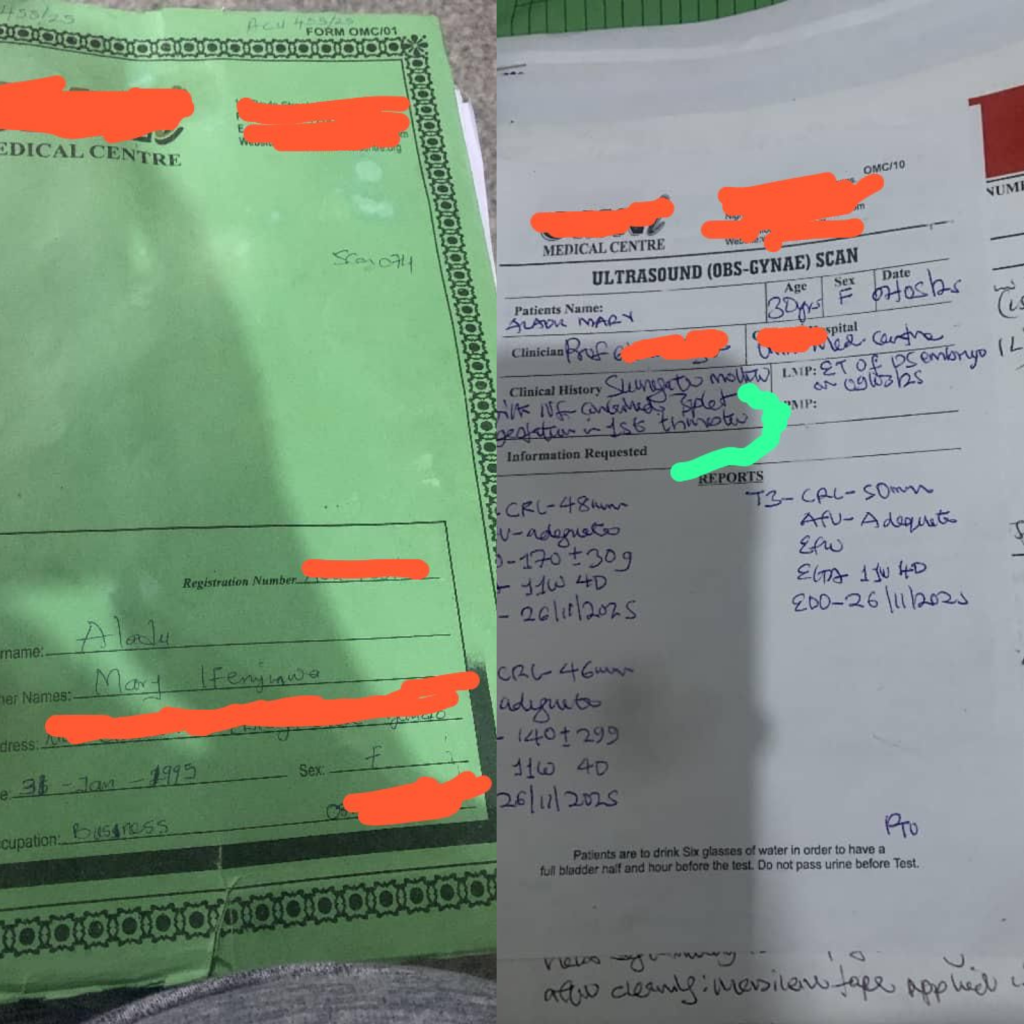
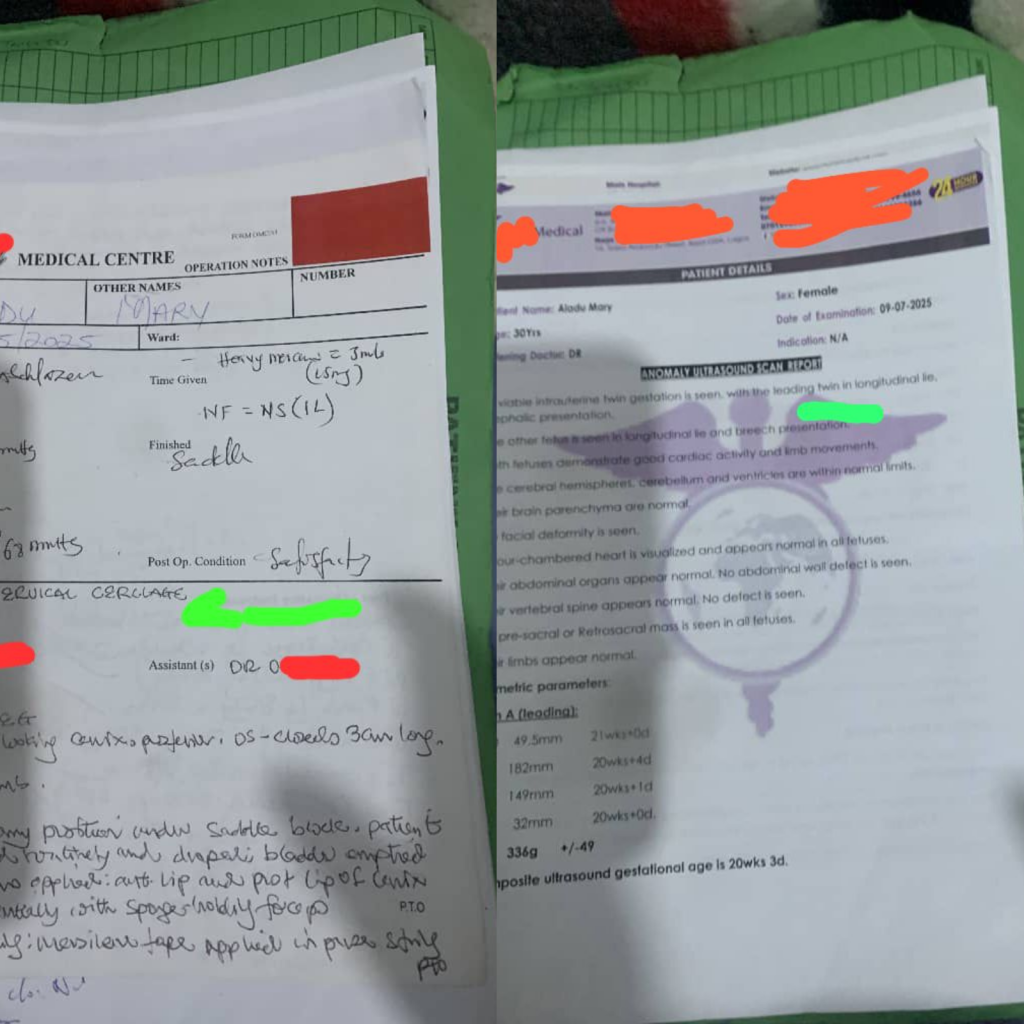
At 14 weeks, Ifenyinwa started experiencing black blood spotting, so she was invited back to the hospital, and after consultation, the surgeons performed cervical cerclage, a procedure used in pregnancy to sew the cervix closed with strong sutures to prevent preterm birth. Research shows that the surgery is done if the cervix is weak.
Ifenyinwa told NFM that the procedure was conducted for her on May 30, 2025. She subsequently requested that the hospital compensate her for the procedure because she was not informed that it was a possible complication she could experience during the pregnancy. However, the hospital declined the request, citing that the procedure was done to save her and the babies’ lives.
A few weeks after the procedure, on July 9, 2025, during an anomaly ultrasound scan, Ifenyinwa discovered that she now carried twins, not triplets.
Ifenyinwa was not offered any explanation of how she could have possibly lost a baby, and as such, she began to fear for the worst.
“I was scared thinking something had happened to my womb because I did not bleed and nothing to show that a baby had left,” Ifenyinwa told NFM, “Through my own research, I discovered that it is normal with IVF, and it is called triplet ethereal syndrome.”
Research shows that there is no recognised condition named “triplet ethereal syndrome,” so NFM consulted a medical practitioner, Eli Miracle, on a possible reason for the foetus’s disappearance. Dr Miracle attributed the occurrence to the possibility of “vanishing syndrome,” caused by irregularities in the babies’ DNA.
“In the first trimester of a woman’s pregnancy, if a fetus is growing and there are problems with the DNA, such that if the body allows the pregnancy to continue, there can be structural or genetic abnormalities, the body itself can stop the pregnancy,” Dr Miracle said. “Just the same way miscarriage occurs when it is a singleton pregnancy, that’s how it can happen in a multiple pregnancy.”
Dr Miracle added that in the case of multiple pregnancies, it is only the foetus with genetic problems that the body rejects, which could be one or two, resulting in a situation where a woman might be carrying a triplet but ends up birthing twins.
On October 31, 2025, Ifenyinwa delivered the babies through a Cesarean Section (CS) and received N3.8 million as compensation for twins brought to life.
‘I thought it was big money’
Ifenyinwa told NFM that before engaging in surrogacy, she believed the compensation was significant, but she soon realised “the money is not even 10% close to the risk and sacrifices she made.”
She used the compensation she received to relocate her son, cousin, and niece from Imo, a South-Eastern State, to Lagos State, a South-Western city. She also used the money to pay her son’s school fees and to support her niece’s training. Within four to five months, all the money was gone, and she was still left with loan debts she had to settle.
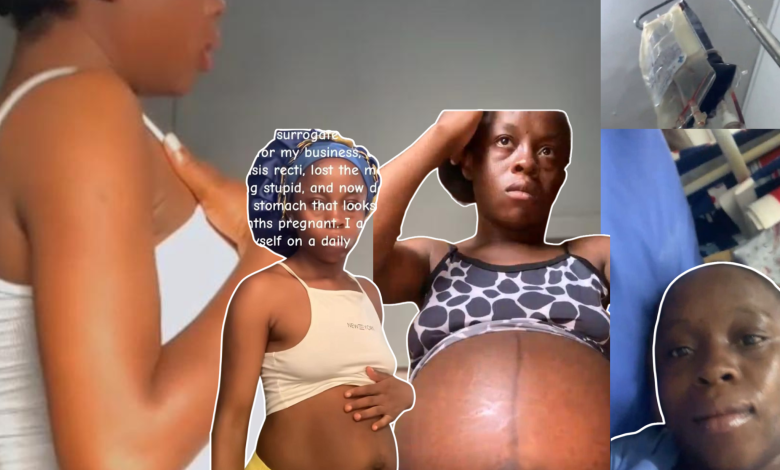
Beyond the financial struggle she was back to, Ifenyinwa had also developed diastasis recti, a condition that causes a consistent protruding belly after childbirth. Medical research indicates that it occurs when the abdominal muscles separate during pregnancy due to stretching, making the belly protrude for months or years after childbirth.
The protruding belly of Ifenyinwa had led to her experiencing serious body dysmorphia, a mental health condition characterised by an intense fixation with a flaw in one’s physical appearance. Although diastasis recti can be treated with exercise, Ifenyiwa said the mental distress she experiences from her physical outlook has left her unmotivated to do anything. The situation, coupled with the money gone and not having access to the babies she had carried and bonded with, plunges her further into the depths of depression.
“It took a lot convincing myself that the babies are not mine or in any way related to me,” Ifenyinwa said, explaining how not having access to the baby and her postpartum body affected her mental health. “It gives me sleepless nights, it is making me slim down, and my tummy is becoming more obvious.”
Expressing regret, Ifenyinwa said, “Surrogacy is not worth it,” adding that she would not advise anyone to go through it, because “it’s a big risk that pays very little compared to the risk.”
She told NFM there were other women she was camped with at the fertility hospital who suffered medical complications. One of the surrogates who grew to become her friend experienced severe bleeding.
“When she had her first menstruation after childbirth, it was as if she were bleeding her whole life,” Ifenyinwa recounted her friend’s experience to NFM, adding that, “She was scared, but I told her to calm down.”
Ifenyinwa’s friend later got medical aid, but the money she had received was also exhausted within a few months.
“She always comes to me to borrow money, but I told her I too don’t have any money again,” Ifenyinwa recounted their mutual financial struggles after surrogacy, adding sadly, “Such is life.”
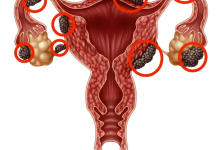
This reporter has also previously documented the experiences of other surrogates who had experienced medical complications and financial hardship shortly after the compensation was received. One surrogate, Temitope, suffered from fibroids and ovarian cysts, and her money ran out in three months.
“Before you even heal from the CS, and the over-stretched stomach, and you are ready to face the world, and restart your life, the money is gone, and your effort is wasted,” Ifenyinwa said, explaining the predicaments many surrogates like her face after the practise.
Ifenyinwa believes surrogacy needs to be eradicated and vulnerable women like single mothers should be educated on the dangers of surrogacy and given financial aid to deter them from engaging in the practice.