|
Getting your Trinity Audio player ready...
|
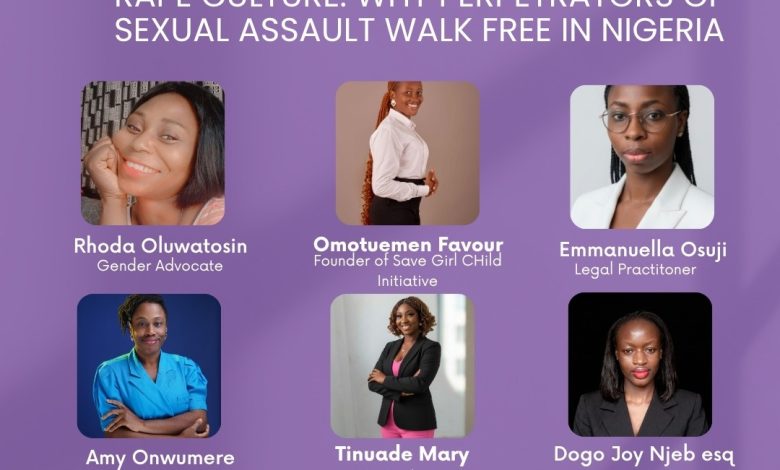
To mark Sexual Assault Awareness Month, Naija Feminists Media (NFM) hosted an X Space discussion on the theme “Rape Culture: Why Perpetrators of Sexual Assault Walk Free in Nigeria.”
The session, held on Friday, April 24, 2026, at 5:00 PM WAT, featured a panel of experts, including Rhoda Oluwatosin Olorunfemi, a human rights journalist and gender advocate; Emmanuella Osuji; and sexual assault survivors Tinuade Mary and Amy Onyinyechi Chinekwu Onwumere.
It had over 100 listeners and was moderated by NFM Executive Assistant Joy Oke, who introduced the topic and noted that the session was organised to commemorate Sexual Assault Awareness Month.
Opening the discussion, Tinuade Mary, a sexual assault survivor, shared her personal experience. She recalled that the situation began in 2023 with persistent harassment from a male neighbour who made unwanted advances despite being married, and it gradually escalated into abuse. According to her, the situation became increasingly frightening, especially after he assaulted her by grabbing her breast.


She said she eventually confronted him and made it clear that his behaviour was unacceptable. However, the confrontation led to further violence, during which he physically attacked her and tore her clothes. She also reported that he continued the harassment by sending explicit videos.
Tinuade noted that she had him arrested after gathering evidence, including audio recordings, text messages, and witness accounts from neighbours. However, the case did not proceed to court due to gaps in its handling. She added that the perpetrator later signed an undertaking and subsequently left the compound.
Providing legal context, Emmanuella Osuji explained that Nigeria’s legal framework addressing rape and sexual assault is governed by multiple laws, including the Penal Code, Criminal Code, and Child Rights Act. She referenced the Violence Against Persons (Prohibition) Act 2015, which defines rape as non-consensual penetration of the body under conditions such as coercion or absence of consent.
“Each of these laws depends on when the offence took place and the age of the survivor,” she said.
Emmanuella also highlighted factors that weaken sexual assault cases in court, including gaps in evidence, medical and forensic limitations, mishandling of physical evidence, and informal or unauthorised settlements.
Speaking on the societal context, Rhoda noted that sexual violence in Nigeria is significantly underreported. She explained that engagement with women in underserved communities often reveals that many have experienced forms of abuse that go unreported.
According to her, a significant challenge is that some survivors do not immediately recognise their experiences as crimes. She added that limited awareness, especially among young girls, means that certain inappropriate or harmful behaviours are not always identified as abuse.
Rhoda further highlighted that sexual violence is more likely to occur in situations where women are isolated, confined, or cut off from support systems. She also pointed out that fear of being blamed rather than believed discourages many survivors from speaking out.
“Organisations such as the Mirabel Centre provide free medical care and counselling services to survivors. Low awareness of these services and insufficient funding remain major barriers to access,” Rhoda said.
Amy Onyinyechi Chinekwu Onwumere identified systemic issues within the justice system as a major factor in low conviction rates. She pointed to burdensome legal requirements, challenges in gathering admissible evidence, and gaps in police training on handling sexual assault cases.
In closing, the experts encouraged survivors to continue seeking justice despite systemic challenges, emphasising the importance of reporting incidents and speaking out. They also called for the urgent need for stronger protections for women and more effective responses to sexual violence and rape.